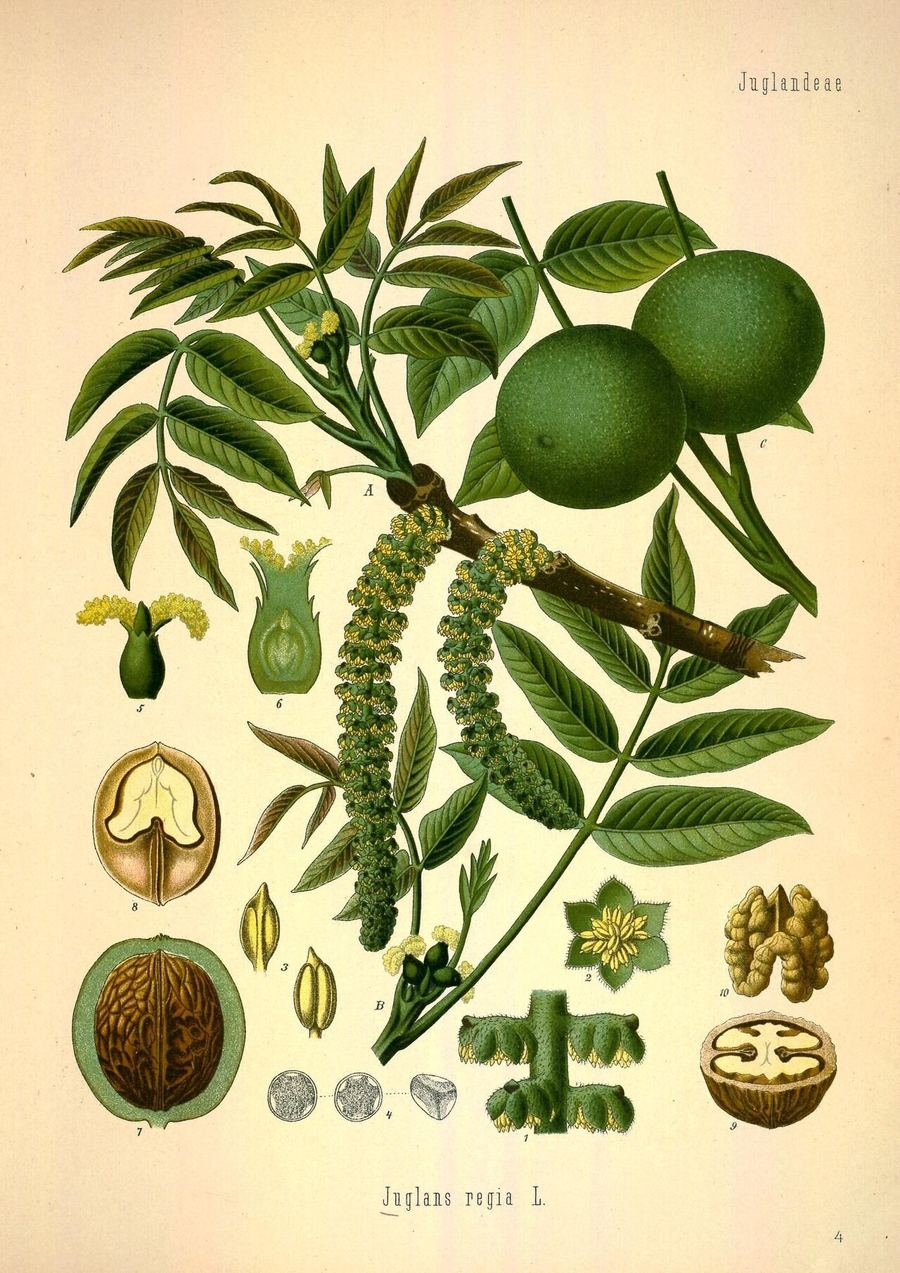
Walnuts
Juglans regia · 胡桃仁
Seeds & Grains. Western & European, Chinese Medicine, Middle Eastern & Unani and Modern nutrition.
Also called English walnut, Persian walnut, Hu tao ren, Akhrot
Pinyin: hú táo rén
Spanish: Nuez
Tree nut allergy riskWalnuts are the edible seeds of the English walnut tree. People eat them as a snack and in baking, and they are a plant source of omega-3 fats.
Did you know? The Latin name Juglans is thought to come from Jovis glans, meaning Jupiter's acorn, a name the Romans gave to this nut.
What it may help, and how strong the proof is
- Cholesterol. Meta-analyses of randomized trials find that walnut-rich diets lower LDL cholesterol, by roughly 5 to 9 mg/dL in different reviews. The drops are modest, and the trials were short.See the research: 132 studies in peopleGood proof
- Heart health. The PREDIMED heart trial gave a Mediterranean diet with 30 grams a day of mixed nuts, including walnuts, and found fewer heart events. The trial was retracted and republished in 2018 after randomization problems, and its main result held.See the research: 93 studies in peoplePromising proof
- Memory & focus. Small human trials show mixed results for memory and thinking. Larger, longer trials are needed before any brain benefit can be claimed.See the research: 23 studies in peoplePromising proof
- Digestion & gut health. Small studies show that walnuts change gut bacteria in ways that may be helpful. Better digestion or gut health has not been shown in trials.See the research: 25 studies in peopleTraditional proof
Parts of the body
Heart & vessels, Liver, Brain & mind, Gut & intestines, Stomach
Traditional use
In Traditional Chinese Medicine, the kernel (hu tao ren) is used to warm the kidneys, ease chronic wheezing and moisten the bowels in older people with dry constipation. Across the Middle East and Europe, walnuts have long been eaten fresh and pressed for oil.
How it is classified
- Herbal actions
- Nutritive, Tonic, Antioxidant. Energy: warming.
- Chinese medicine
- 胡桃仁 Tonify yang. Nature: warm. Flavour: sweet. Enters the Kidney, Lung and Large Intestine channels.
How people take it
Eat about 1 ounce, which is roughly 14 halves, most days as a snack or on salads, oats or yogurt. In TCM, the kernel is usually taken as a decoction. Clinic references give a wide range of doses, so a practitioner should set the amount.
Food, oil and decoction.
Where to get it
Walnut trees are grown widely, with major crops in California, China and Iran. Shelled walnuts, halves and pieces, and walnut oil are sold in supermarkets and health stores, and walnut kernels for TCM are sold in Chinese herb shops.
Be careful
Tree nut allergy is a common food allergy, and it can cause severe reactions. Black walnut hulls and leaves are a different plant that can irritate skin, and they have not been tested as safe medicine. Walnuts in food amounts are generally fine in pregnancy and while nursing. Their calories are high, so portions matter.
Avoid if: tree nut allergy.
Mixing with other things
- Works well together
Both are plant sources of the omega-3 fat ALA, and both are often mixed into oatmeal and breakfast foods.
- Works well together
Walnuts and olive oil are both core parts of the Mediterranean diet, which was tested in the PREDIMED heart trial.
- Works well together
Both tree nuts were part of the nut mix tested in the PREDIMED heart trial.
The honest take
Walnuts are a real, food-based source of plant omega-3 fats, and they may modestly lower LDL cholesterol. The heart evidence comes from a large trial of mixed nuts, not from walnuts alone. Brain and gut claims are still early, and TCM uses of the kernel rest on tradition.
Sources
Each “See the research” link opens PubMed, the U.S. National Library of Medicine's index of medical studies, showing only trials and reviews done in people. The number tells you how much a use has been tested, not whether it worked. The proof rating tells you that.
Study counts checked October 2026.