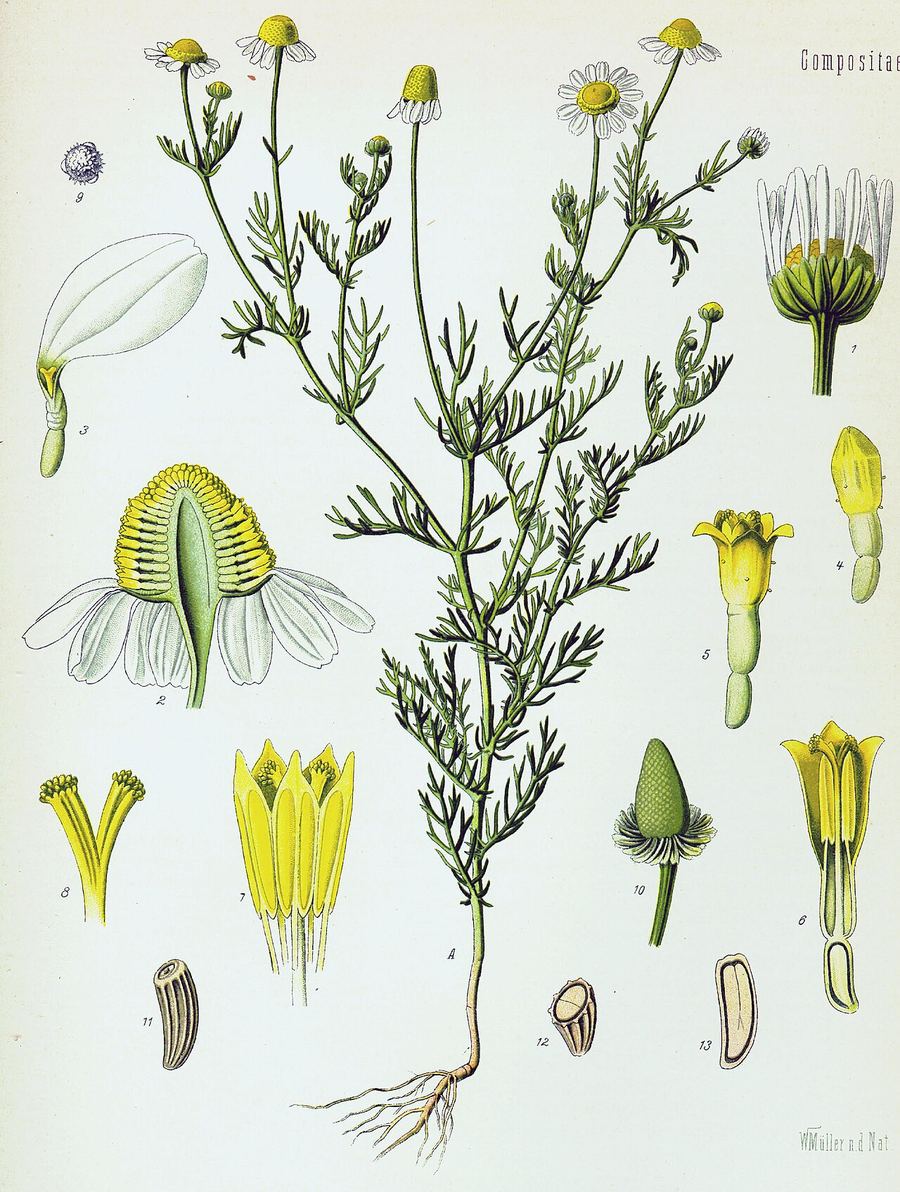
Chamomile
Matricaria chamomilla
Herbs & Roots. Western & European and Dr. Sebi's list.
Also called German chamomile, Wild chamomile, Scented mayweed
Spanish: Manzanilla
Allergy risk (daisy family)Chamomile is a daisy-like flower used mostly as a calming tea for sleep and mild stomach upset.
Did you know? Chamomile's name comes from the Greek 'chamaimelon,' meaning 'earth apple,' because the crushed flowers smell faintly like apples.
What it may help, and how strong the proof is
- Sleep. Small trials suggest better sleep quality, but the studies are short and small.Early proof
- Stress & anxiety. A few small trials of chamomile extract found less anxiety in people with generalized anxiety.Early proof
- Digestion & gut health. Used for stomach cramps and upset, and the support is mostly tradition and lab work.Traditional proof
Parts of the body
Traditional use
European folk herbalists used chamomile for stomach cramps, nerves, and sleep. Its use goes back centuries across Europe.
How it is classified
- Herbal actions
- Carminative, Antispasmodic, Nervine, Anti-inflammatory. Energy: cooling.
How people take it
Most people steep dried flowers in hot water as tea. Anxiety and sleep studies used standardized extract capsules, and the doses varied.
Tea, capsule, tincture and topical.
Where to get it
Grows wild in Europe, Western Asia, and North America, and is widely cultivated. Sold as dried flowers, tea bags, extracts, and oils.
Be careful
Can cause allergic reactions, especially in people sensitive to ragweed or daisy-family plants. It may add drowsiness to sedatives and may increase bleeding with blood thinners. Use with care in pregnancy.
Avoid if: ragweed allergy; pregnancy; bleeding disorders.
Mixing with other things
- Works well together
A classic bedtime blend, combined for sleep.
- Works well together
Often combined in bedtime teas.
- Works well together
Common together in calming tea blends.
- Works well together
Both are in STW 5 (Iberogast), a European stomach blend.
- Works well together
Both are classic evening teas in Europe.
- Works well together
A common bedtime tea blend.
- Works well together
Rooibos and chamomile are often blended into a mild, sweet tea.
- Works well together
Both are gentle folk remedies for cramping and tension. No strong proof for either.
- Works well together
Both are common calming teas after meals or at bedtime.
- Use cautionBlood thinners (warfarin, Eliquis, Xarelto, Plavix, daily aspirin)
Contains coumarin-like compounds, and case reports link it to more bleeding with warfarin.
- Use cautionSleep or anxiety medicine (Ambien, Xanax, Ativan)
Adds to the drowsy effect of sedatives.
- Use cautionAlcohol (beer, wine, spirits)
Alcohol adds to the drowsiness.
Adds up with others that may slow blood clotting: , , , , , , , , , , , , , and 40 more.
Adds up with others that can make you drowsy: , , , , , , , , , , , , , and 14 more.
Found in these formulas
Sleepy-time blend (Western)
The honest take
Chamomile tea is gentle and low-risk, and small trials suggest it may ease mild anxiety and sleep problems. The studies are small and use different products, so the results are hard to compare. Claims that it heals ulcers or lowers fevers have little proof.