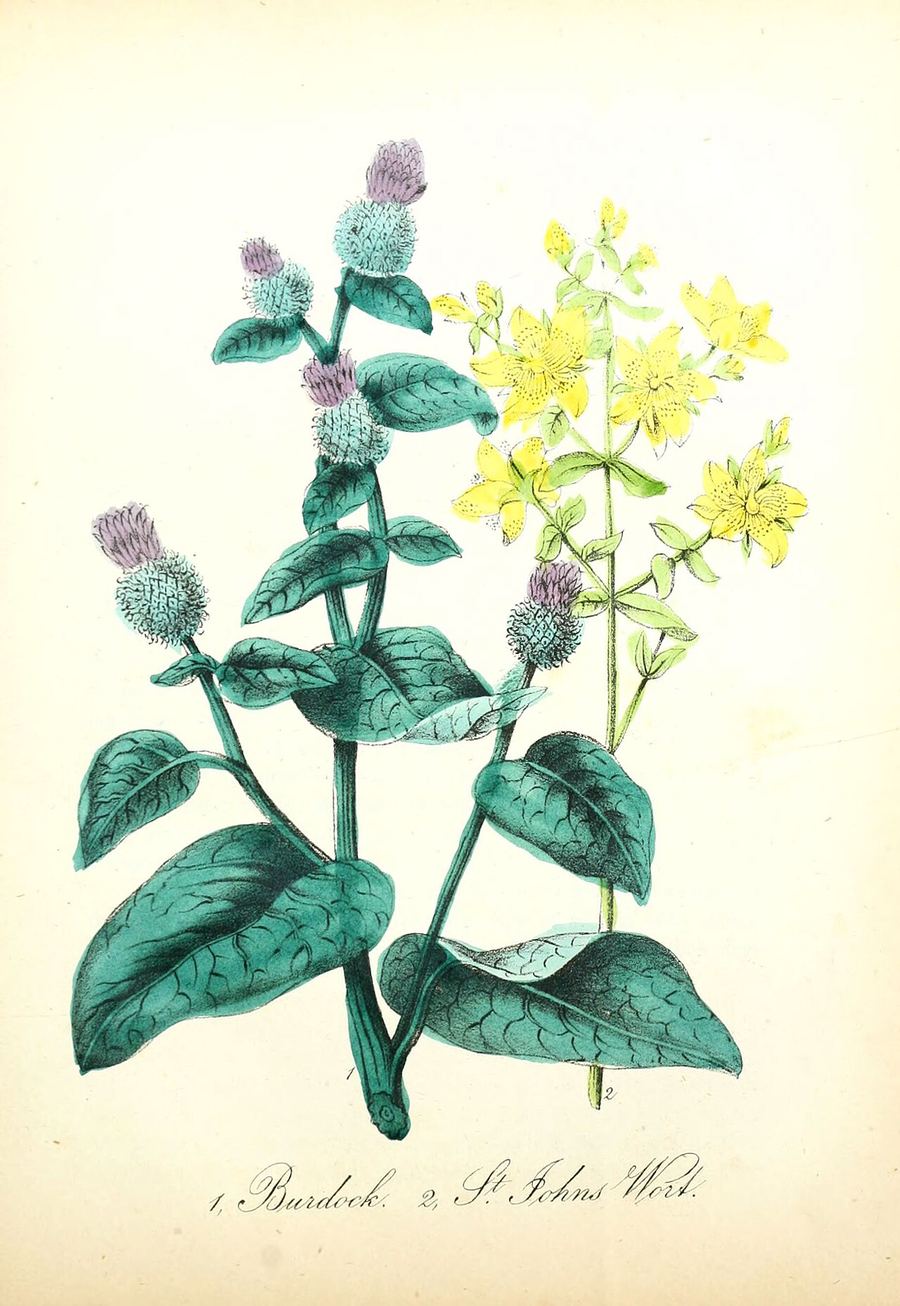
Burdock
Arctium lappa · 牛蒡子
Herbs & Roots. Western & European, Chinese Medicine and Dr. Sebi's list.
Also called Gobo, Greater burdock, Beggar's buttons, Niu bang zi
Pinyin: Niú Bàng Zǐ
Spanish: Bardana
Allergy risk (daisy family)Burdock is a large thistle-like plant whose root is eaten as a vegetable in Japan and used in folk medicine for skin problems.
Did you know? The hooked burrs of burdock inspired Swiss engineer George de Mestral to invent Velcro in the 1940s, after burrs stuck to his clothes and his dog's fur.
What it may help, and how strong the proof is
- Skin. Used in folk medicine for acne, eczema, and boils, but only lab and animal studies exist so far.Traditional proof
- Sore throat & cough. Chinese medicine uses the seed for sore throat, but there are no good human trials.Traditional proof
- Cleansing & detox. Often sold as a blood cleanser, and no good evidence supports that idea.Not supported
Parts of the body
Skin & hair, Mouth & throat, Lungs, Liver, Kidneys & bladder
Traditional use
Western herbalists used burdock for skin problems and as a blood cleansing tonic. In Chinese medicine, the seed, niu bang zi, is used for sore throat and skin rashes.
How it is classified
- Herbal actions
- Alterative, Diuretic, Bitter. Energy: cooling.
- Chinese medicine
- 牛蒡子 Release the exterior. Nature: cold. Flavour: pungent, bitter. Enters the Lung and Stomach channels.
How people take it
The dried root is simmered as tea, and the fresh root is eaten as a vegetable. Tinctures and capsules are sold, but no standard dose has been proven.
Decoction, tea, tincture, capsule and food.
Where to get it
Grows wild in Europe, Asia, and North America along roadsides and fields, and is grown for food in Japan. Sold as dried root, tea, tinctures, and capsules, and the seed is sold in Chinese herb shops.
Be careful
High amounts can cause mild stomach upset. People allergic to ragweed or other daisy-family plants may react. Burdock may lower blood sugar and act as a mild diuretic, so check with a doctor if you take diabetes medicine or water pills.
Avoid if: ragweed allergy; pregnancy; diabetes medicines.
Mixing with other things
- Works well together
Both appear in old spring tonic and blood-cleansing teas.
- Works well together
Traditionally paired in folk alterative blends.
- Works well together
Both are in the Essiac tea blend. Neither has proof for cancer.
- Use cautionDiabetes medicine (metformin, insulin, glipizide, Ozempic)
Animal data suggest burdock can lower blood sugar, so it may add to diabetes medicines.
- Worth knowingWater pills (furosemide, hydrochlorothiazide)
Burdock has mild diuretic effects that could add to water pills.
Adds up with others that may lower blood sugar: , , , , , , , , , , , , , and 39 more.
Found in these formulas
Honeysuckle & Forsythia (TCM), Essiac tea (Native), Sea moss trio (Dr. Sebi)
The honest take
Burdock is a real food with some lab evidence for skin and antioxidant effects, but human trials are few and small. The idea that it cleanses the blood has no good evidence behind it. The seed used in Chinese medicine has not been well tested in people.