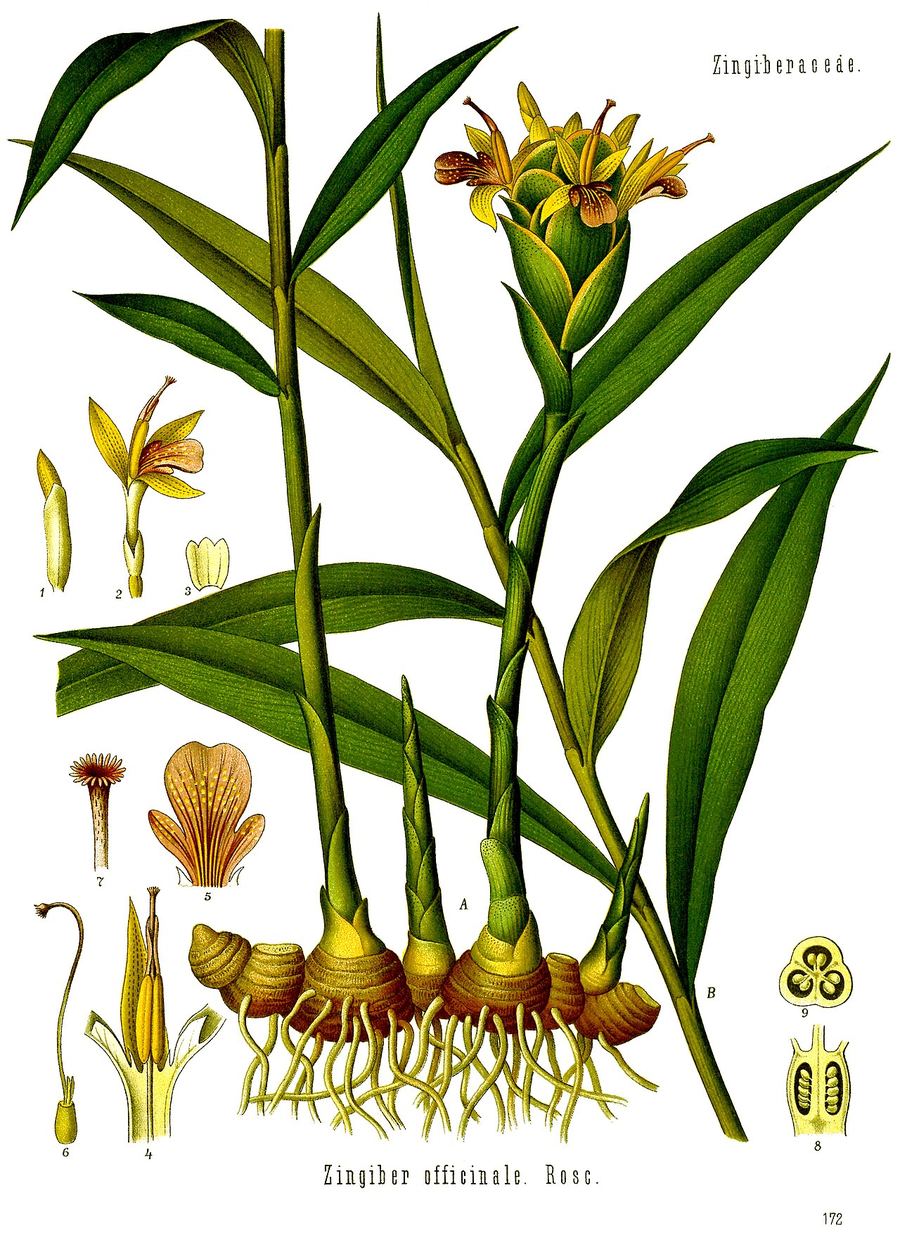
Ginger
Zingiber officinale · 生姜
Spices. Ayurveda, Chinese Medicine, Western & European and Modern nutrition.
Also called Ginger root, Fresh ginger, Dried ginger
Pinyin: Shēng Jiāng
Spanish: Jengibre
Sanskrit: आर्द्रक (Ardraka)
Can add to blood thinnersA knobby root used as a spice and tea, and best studied for nausea and upset stomach.
Did you know? Ginger, cardamom and turmeric all belong to the ginger family, Zingiberaceae.
What it may help, and how strong the proof is
- Nausea & upset stomach. Good trials show ginger eases nausea in pregnancy and some cases after surgery or chemotherapy. Results vary by person.Good proof
- Joint pain & arthritis. Small trials suggest ginger eases osteoarthritis pain a little. Quality is mixed.Early proof
- Women's health. A few small trials suggest ginger may ease period pain. Larger trials are lacking.Early proof
- Sore throat & cough. Ginger tea is a common home remedy for colds, but no good trials prove it helps.Traditional proof
Parts of the body
Stomach, Joints, Hormones & reproduction, Mouth & throat, Lungs
Traditional use
Ayurveda uses fresh ginger (ardraka) and dried ginger (shunthi) to kindle digestion. Chinese medicine uses fresh ginger to release the outside, warm the middle and stop vomiting.
How it is classified
- Herbal actions
- Carminative, Anti-inflammatory, Antispasmodic. Energy: warming.
- Ayurveda
- Calms Vata and Kapha. Can raise Pitta. Taste (rasa): pungent. Energy (virya): heating. After digestion (vipaka): sweet. Deepana (kindles digestion), Pachana (digests toxins/ama).
- Chinese medicine
- 生姜 Release the exterior. Nature: warm. Flavour: pungent. Enters the Lung, Spleen and Stomach channels.
How people take it
Steep 1 inch of sliced root in hot water as tea, or use it in cooking. Studies on nausea often used 250 mg to 1 gram of powdered ginger a day.
Tea, food, capsule and powder.
Where to get it
Grown from rhizomes in warm places such as India, China, West Africa and Jamaica. Sold fresh, dried, powdered, as tea bags and as capsules.
Be careful
Usually well tolerated, but heartburn, mouth irritation and belly upset can happen, and large doses can cause gas or loose stools. Ginger may add to blood thinners and can lower blood sugar and blood pressure a little. People with gallstones should ask a doctor first, since ginger can increase bile flow.
Avoid if: bleeding disorders; gallstones; before surgery.
Mixing with other things
- Works well together
Sometimes used together for migraine relief, based on small studies.
- Works well together
Common in fever and cold teas across the Caribbean and Asia.
- Works well together
Common in jerk marinades with allspice.
- Works well together
Both are pungent spices from the ginger family, Zingiberaceae.
- Works well together
Tulsi and ginger are a common tea pair for colds and upset stomach.
- Works well together
Both are warm root spices used together in Ayurvedic and everyday cooking.
- Works well together
Trikatu, the three pungents, combines pippali, black pepper and ginger in Ayurveda.
- Works well together
Warm blend used in chai and Ayurvedic teas.
- Works well together
Perilla leaf and fresh ginger are often used together for seafood reactions and colds in Chinese folk practice.
- Works well together
Gui Zhi Tang (Cinnamon Twig Decoction) uses cinnamon twig with ginger, white peony and licorice for cold, wind-type symptoms.
- Works well together
Used with ginger for nausea in classic stomach-settling formulas.
- Works well together
Paired with fresh ginger in Wu Zhu Yu Tang for stomach cold.
- Works well together
Ginger and honey are a classic cough and sore throat pairing in folk remedies.
- Works well together
Lemon and ginger tea is a common home remedy for nausea and sore throats.
- Works well together
Orange and ginger are a common juice and tea combination.
- Works well together
Ginger is another key kimchi flavor, along with garlic.
- Works well together
Garlic and ginger together flavor many Asian and Indian dishes.
- Works well together
A close relative, used together in Southeast Asian and Indian cooking.
- Use cautionBlood thinners (warfarin, Eliquis, Xarelto, Plavix, daily aspirin)
Ginger may slow platelets a little and can add to blood thinners.
- Worth knowingDiabetes medicine (metformin, insulin, glipizide, Ozempic)
Ginger may lower blood sugar a little.
- Worth knowingBlood pressure medicine (lisinopril, amlodipine, losartan)
Ginger may lower blood pressure a little.
Adds up with others that may slow blood clotting: , , , , , , , , , , , , , and 40 more.
Found in these formulas
Trikatu (Ayurveda), Golden milk (Ayurveda), Masala chai (Ayurveda), Free & Easy Wanderer (TCM), Pinellia & Magnolia (TCM), Fire cider (Folk), Elderberry syrup (Western), Digestive bitters (Western), Jamaican roots tonic (Caribbean), Sorrel drink (Caribbean)
The honest take
Ginger has real help for nausea, with decent trial evidence. Results for joint and period pain are small and mixed. Ginger is safe as food, but claims that it burns fat or fights infections are not shown in people.