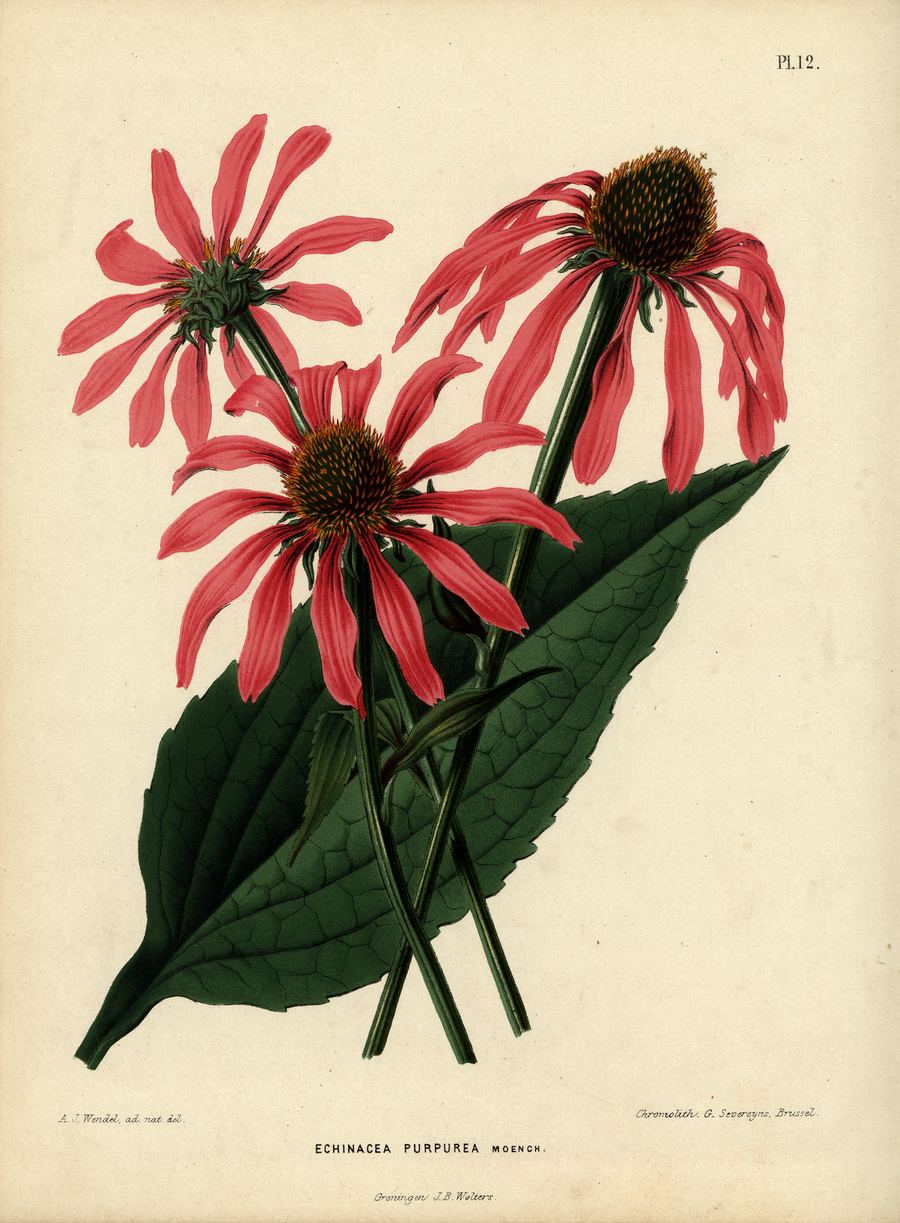
Echinacea
Echinacea purpurea
Herbs & Roots. Native American and Western & European.
Also called Purple coneflower, Black sampson, Coneflower
Spanish: Equinácea
Allergy and immune-drug risksA purple prairie flower whose root and flowering top are mostly used to try to prevent or shorten colds.
Did you know? Its name comes from the Greek word echinos, meaning hedgehog, because the flower's cone-shaped center is covered in spiny bristles.
What it may help, and how strong the proof is
- Colds, flu & immunity. Some trials show a small drop in colds, but others do not. A 2014 review of 24 trials found no clear overall benefit.Early proof
- Sore throat & cough. Used as a tea or lozenge for sore throat. Few human studies exist.Traditional proof
- Infections. Lab tests show some germ-fighting action. Human proof for other infections is lacking.Traditional proof
Parts of the body
Traditional use
Many Plains tribes used echinacea for wounds, snakebites and infections. In the 1800s, American doctors called Eclectics made it a popular remedy.
How it is classified
- Herbal actions
- Immune booster, Alterative, Anti-inflammatory. Energy: cooling.
How people take it
Tea is usually made from 1 to 2 teaspoons of dried root or leaf per cup. Capsules and tinctures follow the label. Cold studies used many different products, so no single dose is proven.
Tea, tincture, capsule, juice and lozenge.
Where to get it
Native to the central and eastern United States. Most products use farm-grown plants. Sold as dried root, tea, capsules, tinctures, juice and lozenges.
Be careful
Mild side effects include upset stomach, dizziness and rash. People allergic to ragweed or other daisy-family plants can have allergic reactions. Rare liver injury has been reported with some products. Use with care if you have an autoimmune disease or take drugs that calm the immune system.
Avoid if: autoimmune disease; ragweed allergy; pregnancy.
Mixing with other things
- Works well together
Often sold together for colds and flu, with little proof that the mix works better.
- Works well together
A common US cold blend. Neither herb has strong proof for colds.
- Works well together
Both appear in folk cold and infection blends.
- Works well together
Both are sold as immune-support herbs, but no trial tests them together.
- Works well together
Both are used for colds and immune support in Western herbalism.
- Works well together
Both are sold for colds and coughs. Combined use is common, with limited proof.
- Use cautionImmune-suppressing medicine (transplant drugs, some arthritis drugs)
May work against drugs that calm the immune system, such as those used after organ transplants.
Found in these formulas
Cold-season kit (Modern)
The honest take
Echinacea is one of the more studied herbs, but results are mixed. Some trials show a small drop in colds, and others show none. Products vary a lot in plant part and strength, so it does not reliably cure or prevent colds.