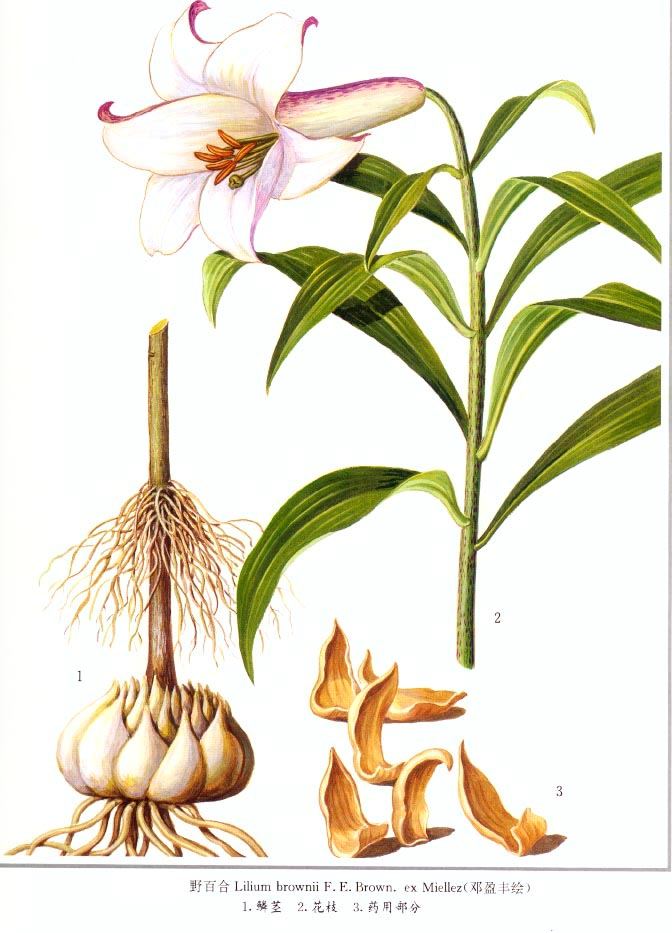
Lily bulb (bai he)
Lilium brownii · 百合
Herbs & Roots. Chinese Medicine.
Also called Baihe, Tiger lily bulb
Pinyin: Bǎi Hé
Lily bulb is the scaly bulb of true lilies, eaten as food and used in Chinese medicine to moisten the lungs and calm a dry cough.
Did you know? Its Chinese name, bai he, is often translated as 'hundred unions,' a name linked to the many scales that make up each bulb.
What it may help, and how strong the proof is
- Sore throat & cough. Used in Chinese medicine for dry coughs and sore throat. Human trials are lacking.See the research: No trials in people found yetTraditional proof
- Sleep. Used for restlessness and poor sleep in Chinese medicine. No good human trials have been found.See the research: No trials in people found yetTraditional proof
Parts of the body
Traditional use
Chinese medicine has used lily bulb to moisten the lungs, calm a dry cough and settle a restless heart. The classic Bai He Zhi Mu Tang (Lily and Anemarrhena Decoction) pairs it with anemarrhena.
How it is classified
- Herbal actions
- Nutritive, Antitussive, Tonic. Energy: cooling.
- Chinese medicine
- 百合 Tonify yin. Nature: cool. Flavour: sweet, bitter. Enters the Heart and Lung channels.
How people take it
Most people eat it cooked in soups, porridge or stews, often with lotus seed. Chinese herb references give a wide range of about 6 to 30 grams of dried bulb per day, so follow a practitioner's advice or the product label.
Food and decoction.
Where to get it
Grown in China and other parts of East Asia for food and medicine. Fresh bulbs are sold in Asian grocery stores, and dried bulb is sold in Chinese herb shops.
Be careful
As food, lily bulb is generally well tolerated, though large amounts may cause loose stools. Lily flowers and pollen are toxic to cats, so keep the plant away from pets. Avoid medicinal doses in pregnancy unless a clinician agrees.
Avoid if: pregnancy; loose stools; cough with cold or damp phlegm.
Mixing with other things
- Works well together
Paired in Bai He Zhi Mu Tang (Lily and Anemarrhena Decoction) for lingering heat, dry cough and restlessness.
The honest take
Lily bulb is a gentle food with a long history in Chinese kitchens and medicine. Its use for dry cough and restlessness rests mostly on tradition, and human studies are lacking. Claims that it boosts immunity or heals the lungs are not proven.
Sources
Each “See the research” link opens PubMed, the U.S. National Library of Medicine's index of medical studies, showing only trials and reviews done in people. The number tells you how much a use has been tested, not whether it worked. The proof rating tells you that.
Study counts checked October 2026.