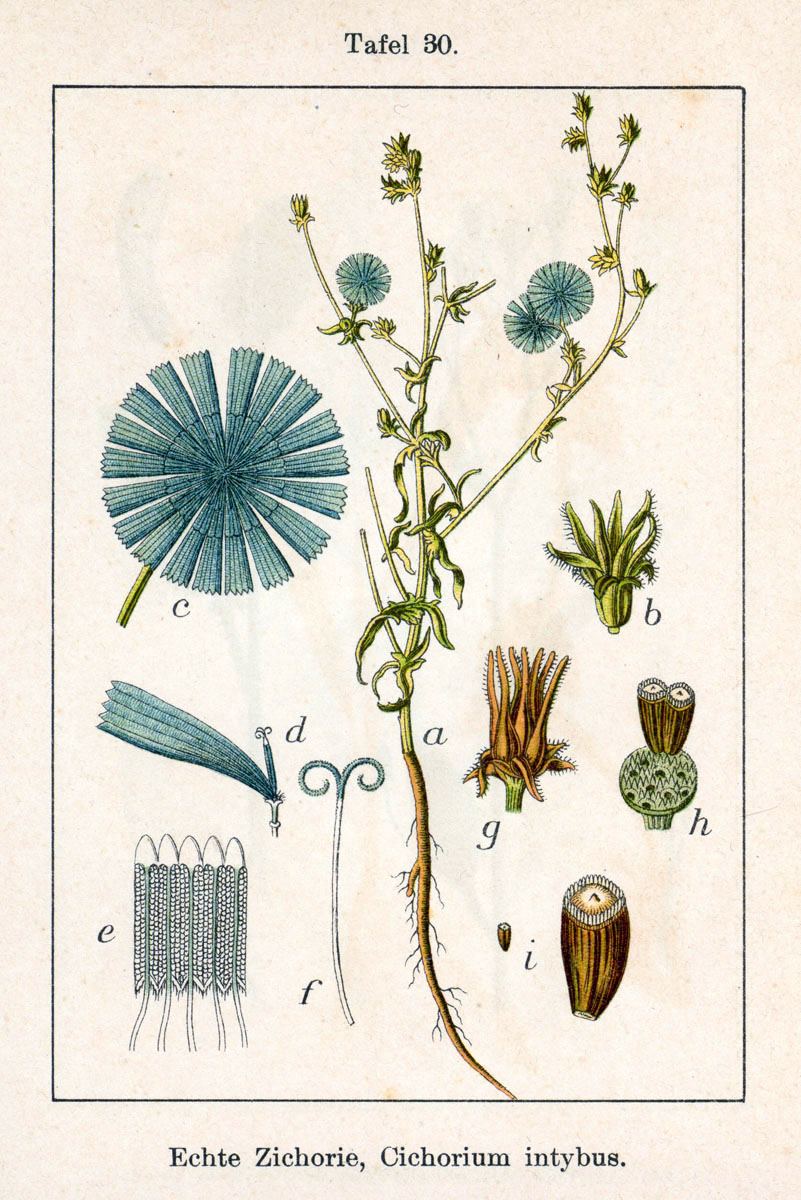
Chicory
Cichorium intybus
Herbs & Roots. Western & European, Middle Eastern & Unani and Folk & home remedies.
Also called Coffeeweed, Wild endive, Succory, Blue dandelion
Pinyin: Jú Jù
Spanish: Achicoria
Gallstone and daisy allergy riskChicory is a blue-flowered roadside plant whose roasted root is used as a coffee substitute and whose fiber, inulin, is sold as a supplement.
Did you know? Roasted chicory root has been mixed into coffee, or used in its place, in Europe since the 1800s, especially when coffee was scarce and expensive.
What it may help, and how strong the proof is
- Constipation. Small trials of chicory inulin, a fiber, found more bowel movements in adults with constipation. Larger, longer trials are needed.See the research: 6 studies in peoplePromising proof
- Digestion & gut health. Inulin feeds helpful gut bacteria. Studies of purified inulin show this, but there is less data on whole chicory root.See the research: 36 studies in peoplePromising proof
- Blood sugar. Animal and lab studies suggest chicory may lower blood sugar. Human studies have not confirmed this, so it should not replace diabetes care.See the research: 14 studies in peopleTraditional proof
- Liver. Herbalists have used chicory for liver and bile complaints for centuries, but no good human trials were found.See the research: 15 studies in peopleTraditional proof
Parts of the body
Traditional use
European herbalists used chicory for digestive complaints, poor appetite and bile flow. Iranian herbal practice took it as a diuretic and laxative and to support the liver, gallbladder and appetite.
How it is classified
- Herbal actions
- Bitter, Cholagogue, Prebiotic. Energy: cooling.
How people take it
The roasted root is brewed like coffee, and there is no standard dose for tea. Studies of chicory inulin used about 10 to 12 grams a day, mixed into food or drinks.
Tea, food, powder and capsule.
Where to get it
Grows wild along roadsides and in fields across Europe, Asia and North America, and is also grown as a crop. Sold as roasted root for coffee blends, dried root, inulin powder and capsules. Radicchio and Belgian endive are also chicory, and you can find them in grocery stores.
Be careful
Chicory is generally well tolerated as food, but inulin can cause gas, bloating and belching. It may stimulate bile flow, so avoid it with gallstones or a blocked bile duct, and people allergic to ragweed or daisies may react. Medicinal amounts are not studied in pregnancy or breastfeeding, so stick to food amounts then.
Avoid if: gallstones; ragweed allergy; diabetes medicines; pregnancy.
Mixing with other things
- Works well together
Both are bitter roots used for digestion and liver teas, and both are roasted into coffee-style drinks.
- Works well together
Both are bitter daisy-family roots used in old spring and digestive blends.
- Works well together
Roasted chicory root is blended with coffee in New Orleans and parts of Europe for a darker, earthy taste.
- Use cautionDiabetes medicine (metformin, insulin, glipizide, Ozempic)
Chicory may lower blood sugar, which could add to diabetes medicines and cause low blood sugar.
- Worth knowingWater pills (furosemide, hydrochlorothiazide)
Traditional sources describe a mild diuretic (water-removing) effect, which could add to water pills.
Adds up with others that may lower blood sugar: , , , , , , , , , , , , , and 54 more.
The honest take
Chicory root is a real source of inulin fiber, and small trials of that fiber show more bowel movements. Its uses for the liver and blood sugar are still mostly lab and animal work. Food amounts are a sensible way to try it, but people with gallstones or ragweed-type allergies should be careful.
Sources
Each “See the research” link opens PubMed, the U.S. National Library of Medicine's index of medical studies, showing only trials and reviews done in people. The number tells you how much a use has been tested, not whether it worked. The proof rating tells you that.
Study counts checked October 2026.