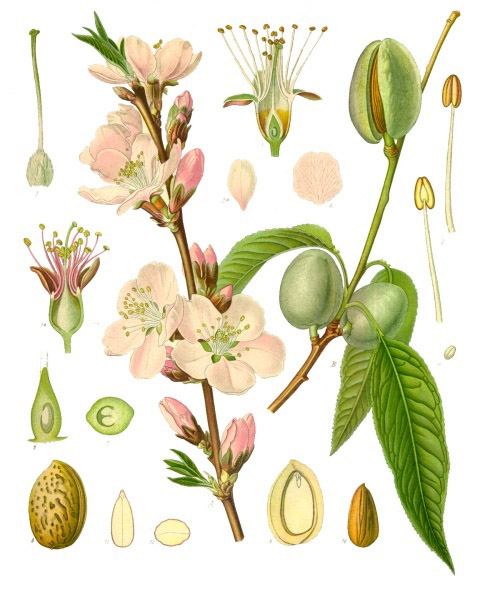
Almonds
Prunus dulcis
Seeds & Grains. Ayurveda, Middle Eastern & Unani and Modern nutrition.
Also called Sweet almond, Badam, Almond kernel
Spanish: Almendra
Bitter kernels release cyanideAlmonds are the seeds inside the fruit of a tree. They are eaten as a snack and used in baking, milk, butter and oil.
Did you know? Almonds are the seeds of a fruit from the same genus as peaches and plums, which is why the almond is sometimes called a stone fruit seed.
What it may help, and how strong the proof is
- Cholesterol. Meta-analyses of randomized trials find a small LDL drop, about 5 mg/dL, but results differ between reviews. A 2016 review was funded by the Almond Board of California, and an earlier review found no LDL drop. The trials are small.See the research: 107 studies in peoplePromising proof
- Blood sugar. Small trials show that eating almonds with a meal blunts the blood sugar rise after it. Long-term blood sugar control has not been proven.See the research: 67 studies in peoplePromising proof
- Weight. Studies find that almonds do not cause weight gain when they replace other snacks. Their fat and protein help people feel full, but large weight loss has not been shown.See the research: 96 studies in peoplePromising proof
Parts of the body
Heart & vessels, Liver, Pancreas & blood sugar, Energy & metabolism
Traditional use
Almonds have been eaten in the Middle East and South Asia for thousands of years, and they are used in many sweets and drinks across the region. In Ayurveda, almonds (badam) are valued as a nourishing food, although classical descriptions differ between texts.
How it is classified
- Herbal actions
- Nutritive, Antioxidant, Tonic. Energy: neutral.
How people take it
Eat about 1 ounce, which is roughly 23 almonds, a day as a common serving. Studies have used anywhere from about 20 to over 100 grams a day. Almond butter, milk and flour are common ways to eat them, and almond oil is used on skin.
Food, oil and topical.
Where to get it
Almond trees are grown mainly in California, with other crops in Spain, Australia and Iran. Almonds are sold raw, roasted, blanched, sliced, as flour, butter, milk and oil.
Be careful
Sweet almonds are safe for most people in food amounts. Bitter almonds and apricot kernels contain amygdalin, which the body turns into cyanide. Case reports suggest that as few as 6 to 10 raw bitter almonds can cause serious poisoning in an adult, and fewer can harm a child, so do not eat raw bitter almonds or apricot kernels. Almonds are a tree nut, and allergy can be severe. Food amounts are generally fine in pregnancy.
Avoid if: tree nut allergy.
Mixing with other things
- Works well together
Dates stuffed with almonds, or eaten together, are a classic snack across the Middle East.
- Works well together
Both tree nuts were part of the nut mix tested in the PREDIMED heart trial.
The honest take
Sweet almonds are a real, food-based choice for heart health, and some trials show a modest LDL drop. The evidence for blood sugar and weight is smaller. Bitter almonds and apricot kernels are dangerous, and Ayurvedic and folk uses for strength rest on tradition rather than trials.
Sources
Each “See the research” link opens PubMed, the U.S. National Library of Medicine's index of medical studies, showing only trials and reviews done in people. The number tells you how much a use has been tested, not whether it worked. The proof rating tells you that.
Study counts checked October 2026.