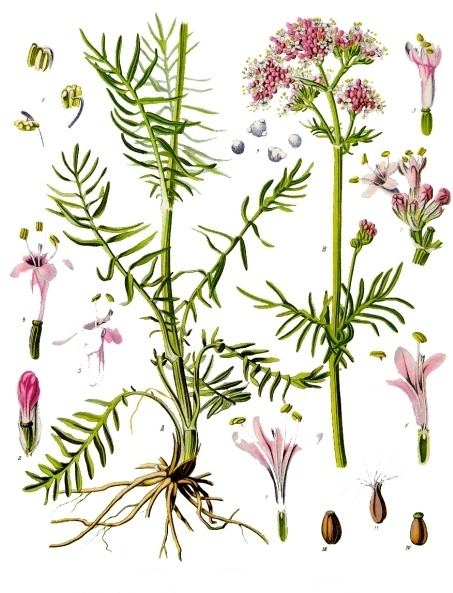
Valerian
Valeriana officinalis
Herbs & Roots. Western & European and Dr. Sebi's list.
Also called All-heal, Garden heliotrope, Common valerian, Setwall
Spanish: Valeriana
Rare liver injury reportedValerian is a root used as a sleep aid and calming herb, with research that is mixed.
Did you know? Valerian root smells like old socks because it contains isovaleric acid, the same compound that gives sweaty feet their smell.
What it may help, and how strong the proof is
- Sleep. Some small trials show easier sleep, but large reviews find no clear benefit over placebo.Early proof
- Stress & anxiety. Used for nerves and anxiety, but human research is limited.Traditional proof
Parts of the body
Traditional use
European herbalists have used valerian for nerves and sleep since ancient Greek and Roman times. It is a classic sleep herb in Europe.
How it is classified
- Herbal actions
- Sedative, Nervine, Antispasmodic. Energy: warming.
How people take it
Dried root is steeped in hot water or taken as capsules or tablets, usually in the evening. Doses in trials vary widely, and no standard amount is proven.
Tea, capsule, tincture and tablet.
Where to get it
Native to Europe and Asia and grown in gardens. Sold as dried root, tea, capsules, and tinctures. The root has a strong smell that many people dislike.
Be careful
Can cause headache, dizziness, stomach upset, and morning grogginess. It adds to sedatives and alcohol. Rare liver injury has been reported, so stop and call a doctor if you notice dark urine or yellow skin.
Avoid if: liver disease; pregnancy; before surgery.
Mixing with other things
- Works well together
A classic bedtime blend, combined for sleep.
- Works well together
Common together in calming blends for sleep and nerves.
- Works well together
A classic European sleep combination.
- Works well together
Often combined in calming sleep blends.
- Works well together
A traditional nerve and sleep combination.
- Works well together
A common sleep combination.
- Works well together
Often sold together for calm and sleep.
- Works well together
Both are common sleep teas.
- Works well together
Sleep blends sometimes pair the two, but their combined effect is not well studied.
- Works well together
Both are used for sleep and sometimes sold together. Evidence for the combination is limited.
- Use cautionSleep or anxiety medicine (Ambien, Xanax, Ativan)
Adds to sedatives and can cause heavy drowsiness.
- Use cautionAlcohol (beer, wine, spirits)
Adds to the drowsy effect of alcohol.
Adds up with others that can make you drowsy: , , , , , , , , , , , , , and 14 more.
Found in these formulas
Sleepy-time blend (Western)
The honest take
Valerian is one of the most studied sleep herbs, but the results are mixed. Some small trials show easier sleep, while large reviews find no clear benefit over placebo. It seems fairly well tolerated for short use, but the evidence for sleep is weak.