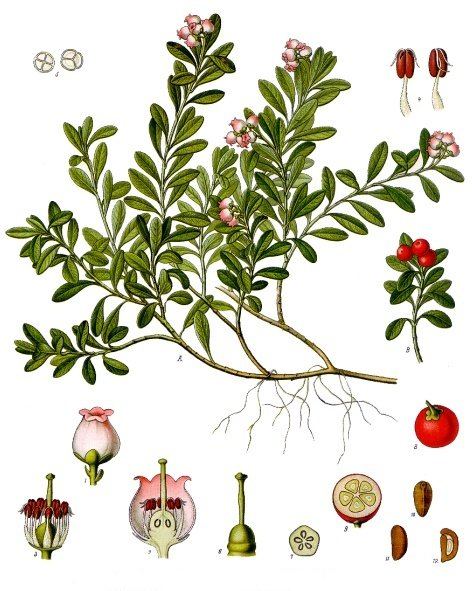
Uva ursi
Arctostaphylos uva-ursi
Herbs & Roots. Native American and Western & European.
Also called Bearberry, Kinnikinnick, Bear's grape
Spanish: Gayuba
Only for short-term useA low evergreen shrub whose leaves are brewed as a short-term tea for bladder irritation.
Did you know? Its Latin name means bear's grape, and Native peoples mixed its leaves into smoking blends called kinnikinnick.
What it may help, and how strong the proof is
- Kidneys, bladder & UTIs. Used for bladder infections and kidney complaints for a long time. Few human studies exist.Traditional proof
- Infections. Lab tests show some action against common bladder germs. Human proof is lacking.Traditional proof
Parts of the body
Traditional use
Native peoples of northern North America used the leaves for bladder and kidney complaints. European herbalists took up the herb in the 1800s for urinary infections.
How it is classified
- Herbal actions
- Diuretic, Astringent, Antimicrobial. Energy: cooling.
How people take it
Typical tea is made from about 1 to 2 grams of dried leaf, up to three times a day. Use for no more than about one week for mild bladder symptoms, unless a doctor says otherwise.
Tea, capsule and tincture.
Where to get it
Grows as a low, mat-forming evergreen in sandy and rocky soils across northern North America, Europe and Asia. Leaves are wild-picked or farmed. Sold as dried leaves, tea, capsules and tinctures.
Be careful
Can cause nausea, and it may turn urine dark green or brown. Regulators in Europe limit use to about one week, partly because of its hydroquinone-related chemicals. Avoid in pregnancy, breastfeeding, children and people with kidney disease.
Avoid if: pregnancy; breastfeeding; kidney disease; children under 12.
Mixing with other things
- Works well together
Both are used for urinary complaints, though cranberry has better trial support.
- Works well together
Both are used in classic urinary tea blends.
- Works well together
Common in urinary tea blends with other diuretic herbs.
- Works well together
Both are used in traditional urinary tea blends.
- Works well together
Both are old urinary herbs that often appear together in traditional blends.
- Use cautionWater pills (furosemide, hydrochlorothiazide)
Can add to the water-loss effect of diuretic drugs, so watch for dizziness or dehydration.
The honest take
Uva ursi has a long history for bladder problems, but there is little modern human research. Its arbutin can break down to hydroquinone, which is why use is limited to about a week. A true urinary infection needs a doctor, not a tea.