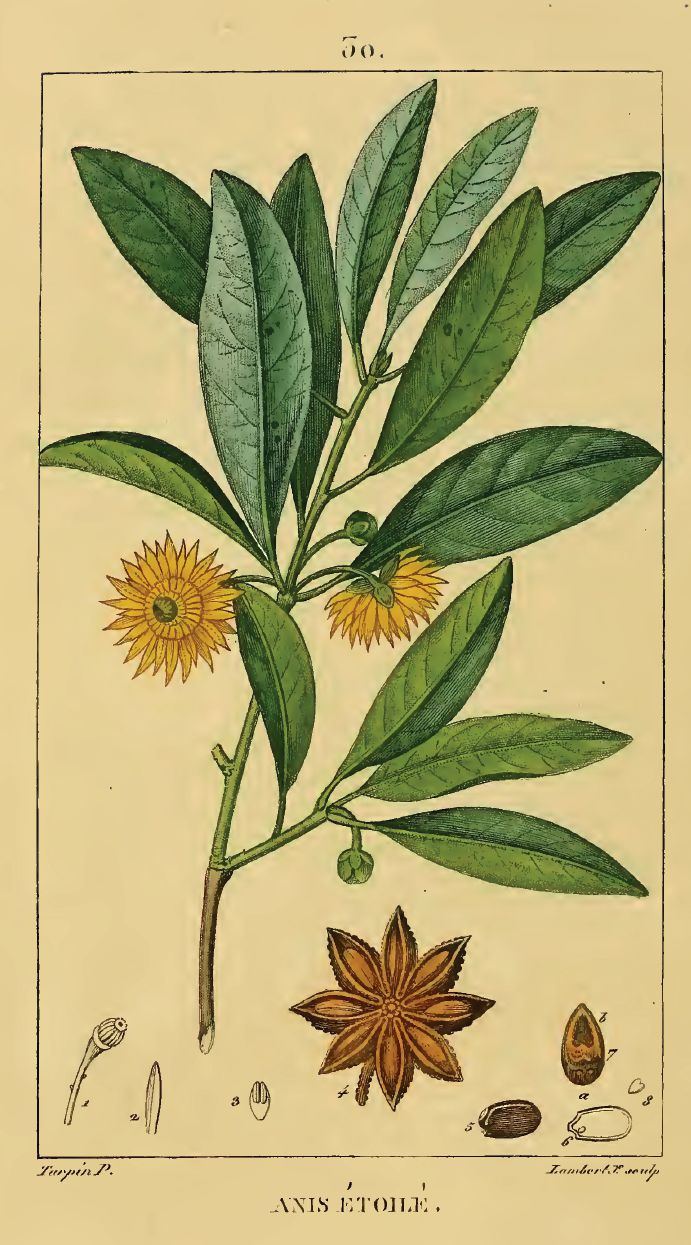
Star anise
Illicium verum · 八角茴香
Spices. Chinese Medicine.
Also called Chinese star anise, Badiane, Chakra phool, Bā jiǎo
Pinyin: Bā Jiǎo Huí Xiāng
Spanish: Anís estrellado
Toxic look-alike; avoid for babiesA star-shaped spice from a Chinese evergreen tree, used to flavor food, including Chinese five-spice powder.
Did you know? Star anise is a main source of shikimic acid, a chemical building block used to make the flu drug oseltamivir (Tamiflu).
What it may help, and how strong the proof is
- Digestion & gut health. Used in tea to ease gas and bloating. Trials in people are lacking, so the proof is mostly tradition.Traditional proof
- Pain & headaches. Chinese medicine uses it for cold-type belly pain. There are no good human trials.Traditional proof
- Infections. Extracts slow some bacteria and fungi in lab dishes. This has not been shown in people.Traditional proof
Parts of the body
Traditional use
Chinese medicine uses star anise to warm the interior, relieve cold-type pain and support digestion. It is a common flavor in Chinese and Indian kitchens.
How it is classified
- Herbal actions
- Carminative, Antimicrobial, Analgesic. Energy: warming.
- Chinese medicine
- 八角茴香 Warm the interior. Nature: warm. Flavour: pungent. Enters the Liver, Kidney, Spleen and Stomach channels.
How people take it
Whole pods or ground spice in cooking, to taste. Some people brew tea from whole pods; use only true Chinese star anise.
Food and tea.
Where to get it
Comes from an evergreen tree native to southern China and northern Vietnam. Sold as whole pods, ground powder and oil; look for Illicium verum, not Japanese star anise.
Be careful
Food amounts are safe for most adults. Japanese star anise (Illicium anisatum) is toxic and has been suspected in illnesses from star anise tea, including seizures in infants. Star anise oil is strong and should not be swallowed in large amounts.
Avoid if: babies and infants; epilepsy; pregnancy (large amounts).
Mixing with other things
- Works well together
Part of Chinese five-spice powder.
- Works well together
Part of Chinese five-spice powder.
- Works well together
Part of Chinese five-spice powder.
- Works well together
Similar anise flavor, often used together in spice blends.
The honest take
Real Chinese star anise is a safe, pleasant spice. The 2003 US warning about star anise tea shows the risk of the toxic look-alike and of giving tea to babies. Health claims for star anise rest on tradition and lab tests.