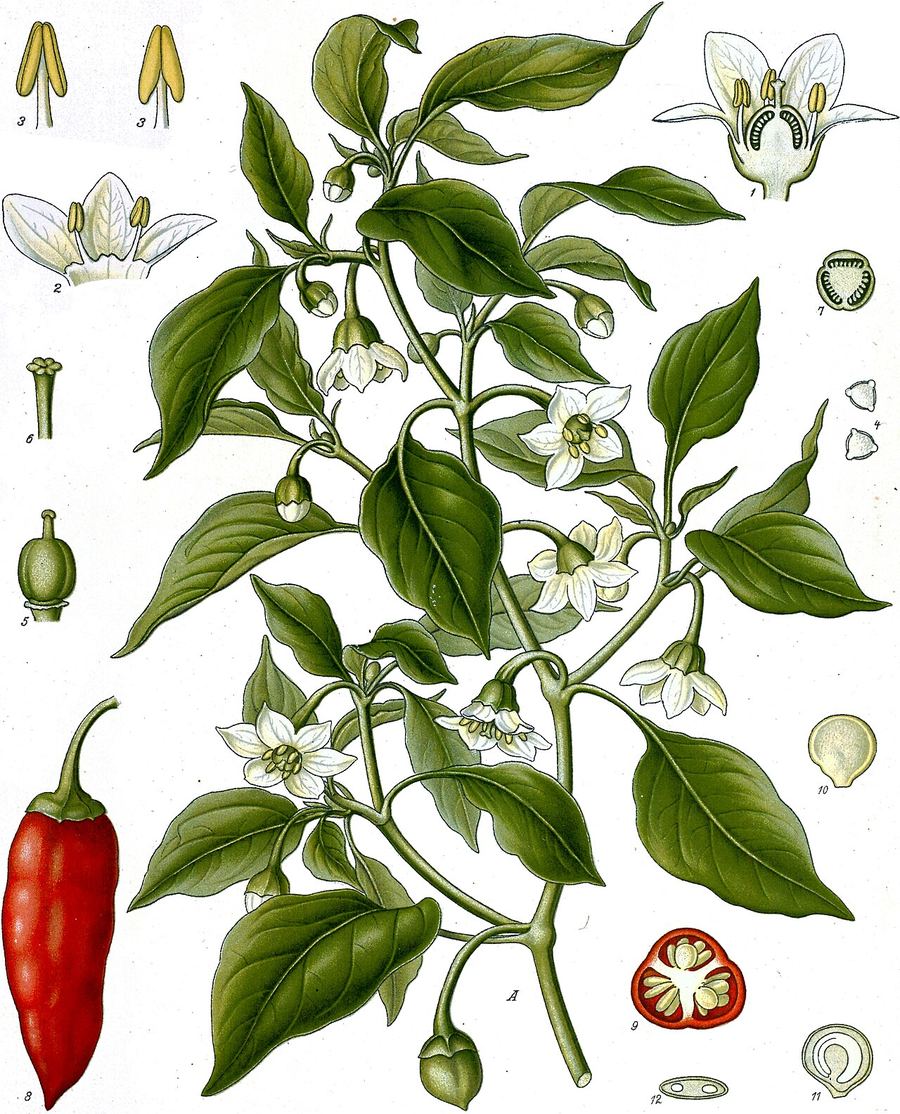
Cayenne & chili
Capsicum annuum / Capsicum frutescens
Spices. Latin American & Amazon.
Also called Chili pepper, Red pepper, Chile, Ground red pepper, Tabasco pepper
Pinyin: Là Jiāo
Spanish: Pimienta de cayena
Can burn skin and eyesThe hot fruit of chili plants, used as a spice and, as capsaicin, in creams for sore joints and nerve pain.
Did you know? Capsaicin makes the brain feel heat by activating a nerve sensor called TRPV1, and the scientist who found that sensor shared the 2021 Nobel Prize in Medicine.
What it may help, and how strong the proof is
- Joint pain & arthritis. Capsaicin cream may ease arthritis pain a little. Trials give mixed results, and the cream stings at first.Early proof
- Weight. Small trials show chili can slightly cut appetite and calorie intake at a meal. Long-term weight loss is not proven.Early proof
- Heart health. A large Chinese study linked chili eating with fewer deaths, but studies that only watch people are not proof. No trials have tested cayenne for heart health.Traditional proof
Parts of the body
Traditional use
Chili peppers were first grown in the Americas thousands of years ago. Folk medicine in Latin America and the Caribbean uses hot peppers for colds, sore throats and aches.
How it is classified
- Herbal actions
- Analgesic, Carminative. Energy: warming.
How people take it
Eaten as a spice, to taste. Capsaicin cream is rubbed on sore spots several times a day, as the label says.
Food, powder and topical.
Where to get it
Chili plants grow in warm regions worldwide. Sold fresh, dried and ground, as flakes, and as capsaicin creams or patches (some patches need a prescription).
Be careful
Food amounts are safe for most people. Capsaicin burns skin, eyes and the mouth, so wash your hands after handling hot chilies and never rub your eyes. Large amounts can cause stomach pain, heartburn and diarrhea.
Avoid if: stomach ulcers; acid reflux; broken skin (creams).
Mixing with other things
- Works well together
Chili and lime on watermelon is a popular snack in Mexico.
- Works well together
Chili and cacao are a traditional Mesoamerican pair in some drinks.
- Works well together
A base for many Mexican and Caribbean salsas and sauces.
- Works well together
A fresh herb often used with chili in salsas and Caribbean sauces.
- Works well together
Mexican dishes often combine dried oregano with chili.
- Works well together
Used together in Mexican bean dishes and salsas.
Found in these formulas
Fire cider (Folk)
The honest take
Chili heat is real, and capsaicin cream has some trial support for sore joints, though it stings at first. Claims that chili burns fat or protects the heart are not proven. The heart link comes only from studies that watch people.