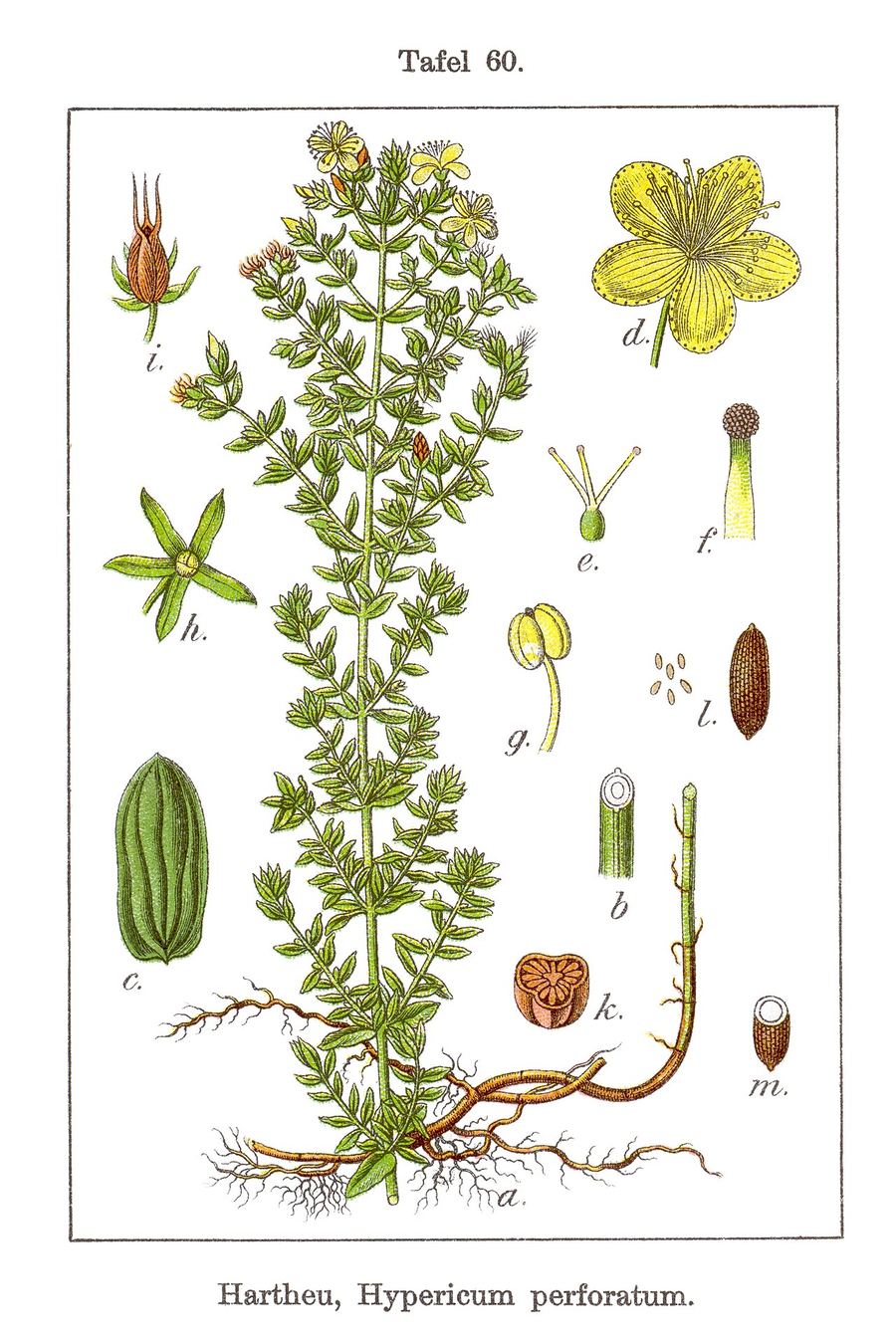
St. John's wort
Hypericum perforatum
Herbs & Roots. Western & European.
Also called Klamath weed, Goatweed, Tipton's weed
Spanish: Hipérico
Clashes with many medicinesA yellow-flowered plant that people mainly use for mild to moderate low mood.
Did you know? Crushed fresh flowers soak oil a deep red, which old folk tales linked to the blood of St. John the Baptist.
What it may help, and how strong the proof is
- Low mood. Several good trials and a Cochrane review found it helps mild to moderate depression, about as well as standard antidepressants in those trials. It has not been shown to help severe depression.Good proof
- Wounds, burns & bites. Used as an oil on minor burns and cuts. Human proof is thin.Traditional proof
Parts of the body
Traditional use
Western herbalists have used it for nerves, sleep, and minor wounds for centuries. Oil made from the flowers was rubbed on sore skin.
How it is classified
- Herbal actions
- Nervine, Anti-inflammatory, Vulnerary. Energy: warming.
How people take it
Most trials used 300 mg of a standardized extract three times a day, for 4 to 12 weeks. Standardized means each capsule has a set amount of the active compound, hypericin.
Tea, capsule, tincture and oil.
Where to get it
Grows wild across Europe, Asia, and North America, and is also farmed. Sold as capsules, tablets, teas, tinctures, and oils.
Be careful
Common side effects include upset stomach, dizziness, and dry mouth. It makes skin very sensitive to sunlight, so use sunscreen and cover up. It can make many prescription drugs work less well, including birth control pills.
Avoid if: pregnancy; bipolar disorder; before surgery; organ transplant.
Mixing with other things
- Works well together
Both are used for nerves and low mood in European herbal blends.
- Works well together
Often sold together for calm and sleep.
- Don't mixAntidepressants (Zoloft, Prozac, Lexapro and others)
Can cause serotonin syndrome, a dangerous build-up of serotonin, when taken with SSRIs, SNRIs, or MAOIs.
- Don't mixBirth control (the pill and other hormonal birth control)
Speeds up how fast the body clears the pill, which can lower its effect and risk pregnancy.
- Don't mixImmune-suppressing medicine (transplant drugs, some arthritis drugs)
Can lower levels of transplant drugs such as cyclosporine, which may lead to rejection.
- Use cautionBlood thinners (warfarin, Eliquis, Xarelto, Plavix, daily aspirin)
Can lower warfarin levels, which raises the chance of clots. Doctors need to check blood tests closely.
- Use cautionHeart rhythm medicine (digoxin, amiodarone)
Can lower levels of digoxin and some other heart drugs.
Adds up with others that may slow blood clotting: , , , , , , , , , , , , , and 40 more.
The honest take
The research is strongest for mild to moderate depression, and some people may find it useful with a doctor's guidance. It is not a proven option for severe depression. The bigger risk is its many drug interactions, some of which can be dangerous.