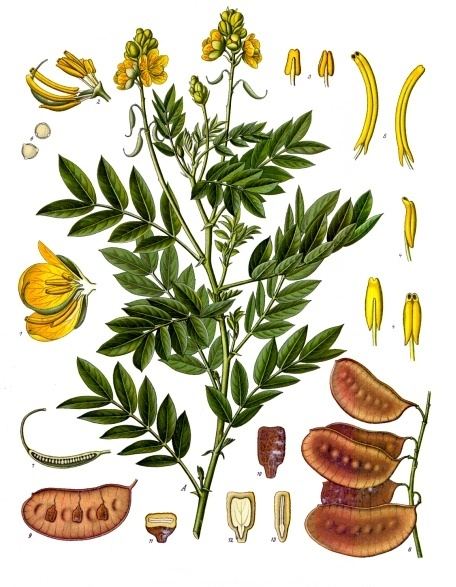
Senna
Senna alexandrina · 番泻叶
Herbs & Roots. Western & European, Middle Eastern & Unani, African, Caribbean and Chinese Medicine.
Also called Alexandrian senna, Tinnevelly senna, Senna leaf, Senna pods
Pinyin: Fān Xiè Yè
Spanish: Sen
Habit forming with long useThe leaves and pods of a desert shrub, used as a strong laxative for short-term constipation.
Did you know? Senna does little on its own. Bacteria in the gut change its sennosides into the active form that makes the bowel contract.
What it may help, and how strong the proof is
- Constipation. Several trials show it works for short-term constipation, usually within about a day. It is not meant for long-term use.Good proof
- Cleansing & detox. Sold as a colon cleanse. The body does not need one, and long-term use can cause dependence and potassium loss.Not supported
- Weight. Some people use laxatives to lose weight. Senna removes water and stool, not fat, and this use is unsafe.Not supported
Parts of the body
Gut & intestines, Liver, Kidneys & bladder, Energy & metabolism
Traditional use
Arab and Egyptian healers used senna as a laxative for centuries, and it passed into European and Unani medicine. Caribbean and African folk healers also used it.
How it is classified
How people take it
Common label doses are 8.6 to 17.2 mg of sennosides at bedtime. Labels say not to use it for more than one week without a doctor's advice.
Tablet, capsule, tea and syrup.
Where to get it
Grown mainly in India, Sudan, and Egypt. Leaves and pods are dried, then sold as tablets, capsules, tea, and syrup in pharmacies and stores.
Be careful
Common side effects are stomach cramps, gas, and loose stools. Heavy use can drain potassium and salt, which can cause weakness and heart rhythm problems, especially with heart drugs. Long-term use can lead to dependence, and the colon may turn brown (melanosis coli), which is harmless but shows heavy use.
Avoid if: pregnancy; breastfeeding; bowel blockage; inflammatory bowel disease; kidney disease; heart disease; children under 12.
Mixing with other things
- Works well together
Psyllium adds bulk and softens stool, while senna moves it. Some people use both for constipation.
- Works well together
A food-based option. Prunes work gently with fiber and natural sugars.
- Use cautionWater pills (furosemide, hydrochlorothiazide)
Both can lower potassium. Using them together raises the risk of dangerously low potassium.
- Use cautionHeart rhythm medicine (digoxin, amiodarone)
Low potassium from senna can make heart medicines such as digoxin more dangerous.
- Use caution
Licorice also lowers potassium, so using both adds risk.
The honest take
Senna works and is one of the best-studied laxatives for short-term constipation. It is not a detox or weight-loss tool, and long-term use can cause dependence and low potassium. Many colon cleanse products contain senna and add risk without extra benefit.