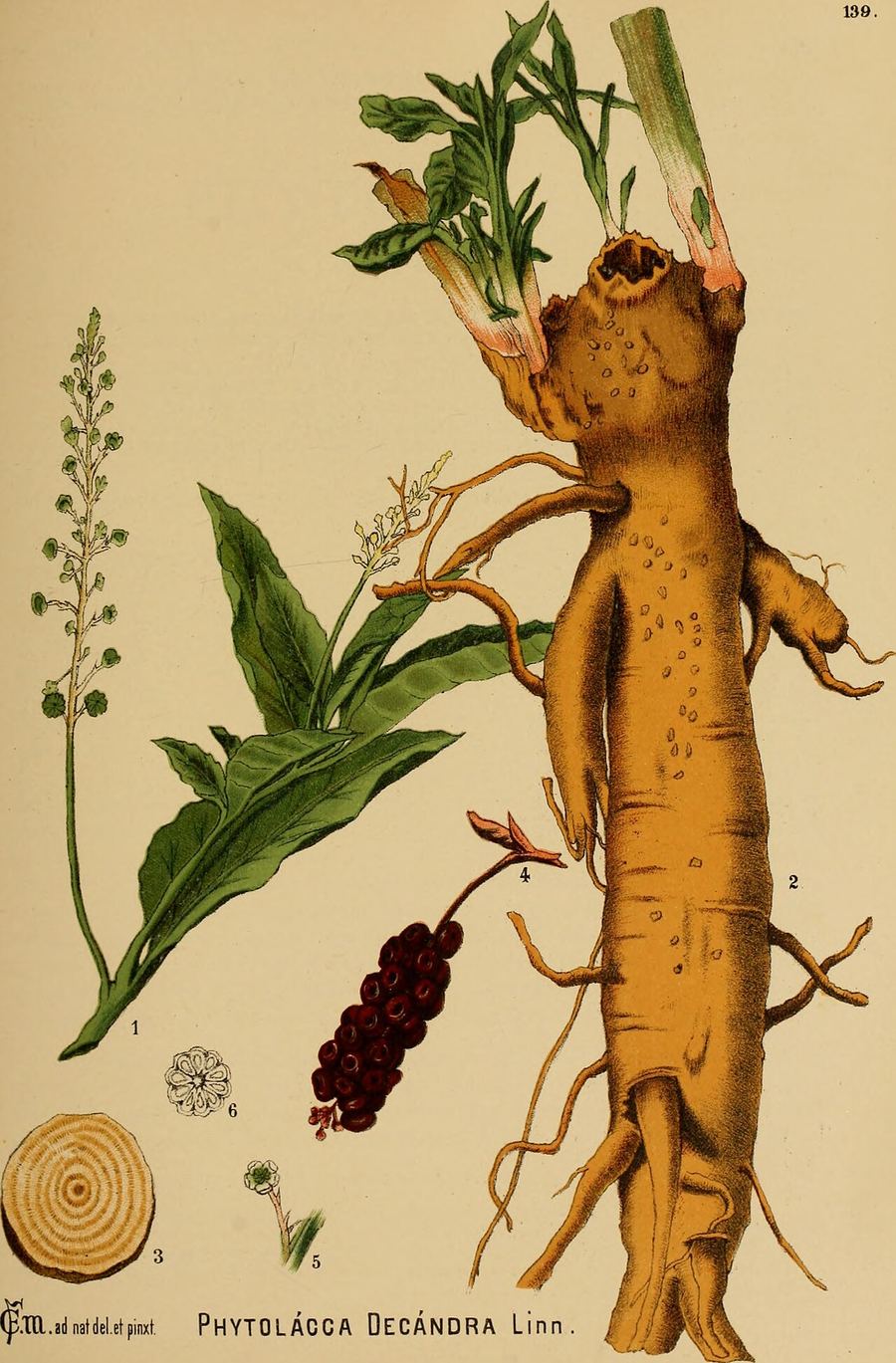
Poke root
Phytolacca americana
Herbs & Roots. Native American and Western & European.
Also called Pokeweed, Pokeberry, Inkberry
Poisonous; do not take internallyA tall plant with purple berries whose root is poisonous and was once used for swellings, skin sores and joint pain.
Did you know? The dark purple juice of its berries was once used as ink and as a dye for cloth.
What it may help, and how strong the proof is
- Joint pain & arthritis. Used for rheumatism in folk medicine. No human studies exist, and the poisoning risk is high.Traditional proof
- Skin. Applied to sores and swellings in folk use. No human studies exist.Traditional proof
Parts of the body
Traditional use
Native peoples used the root in tiny amounts for swellings and skin problems. Folk healers and later Eclectic doctors used it for rheumatism and swollen glands.
How it is classified
- Herbal actions
- Alterative, Lymphatic. Energy: neutral.
How people take it
Not recommended for home use. Old remedies used tiny amounts, and the gap between a folk dose and a poisoning dose is too small to trust.
Topical.
Where to get it
Grows wild in fields, fence rows and disturbed ground across eastern and central North America. Wild-dug roots are the usual source.
Be careful
Poisonous. Raw leaves, roots and unripe berries can cause vomiting, diarrhea, burning mouth, slow heartbeat, low blood pressure and, in severe cases, death. Children are at highest risk from the berries. Do not take it by mouth.
Avoid if: pregnancy; breastfeeding; children under 12; heart disease.
Mixing with other things
No specific mixing notes on file. That doesn't prove it's safe with everything; ask a pharmacist about your full list.
The honest take
Poke root has a folk history for joint pain and swellings, but there is no human research to back it. It is poisonous, and poisoning can happen with small amounts. There is no good reason to use it.