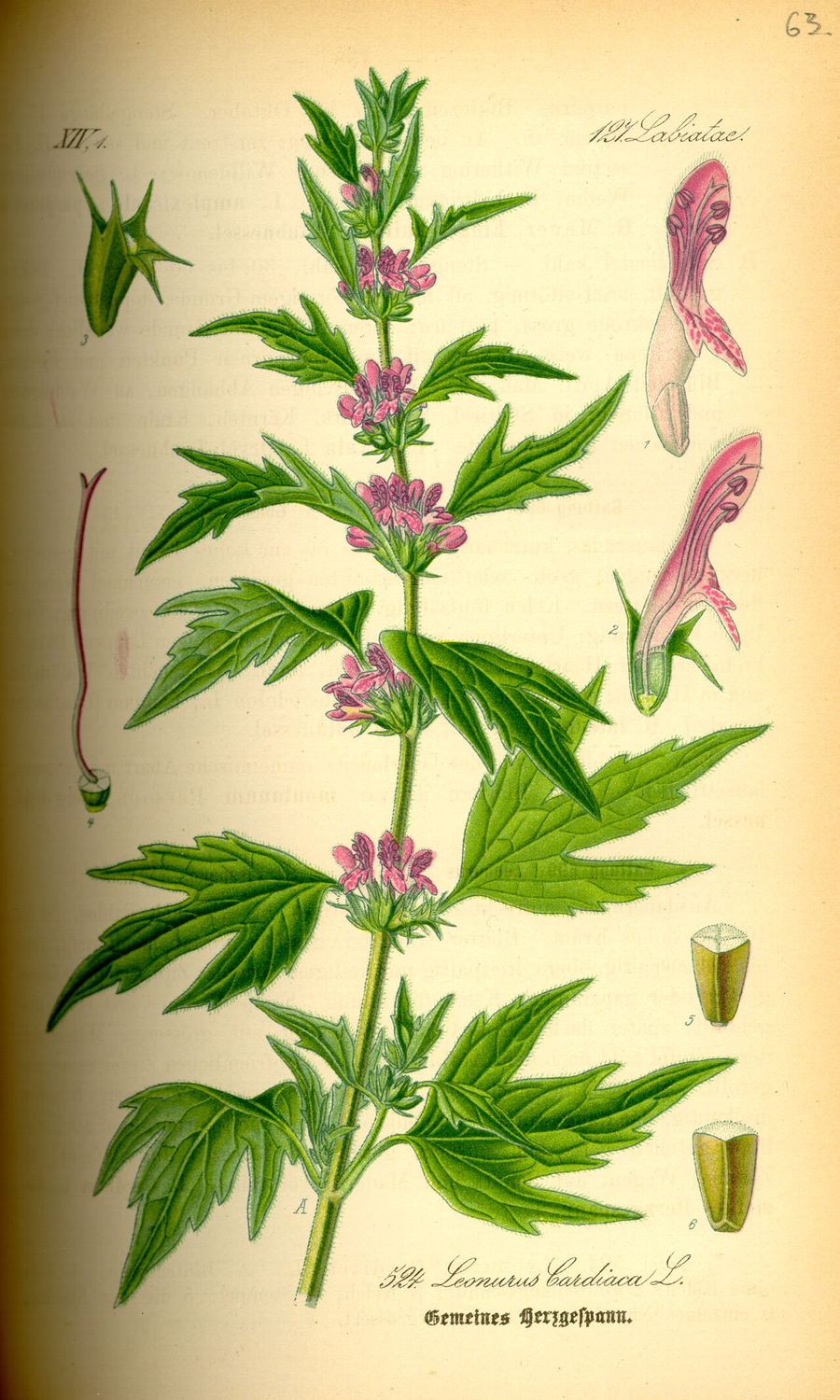
Motherwort
Leonurus cardiaca · 益母草
Herbs & Roots. Western & European and Chinese Medicine.
Also called Lion's tail, Lion's ear, Throwwort
Pinyin: Yì Mǔ Cǎo
Spanish: Cola de león
Avoid in pregnancyA mint-family herb used for nerves, a racing heart, and period problems.
Did you know? Its Chinese name, yi mu cao, means roughly benefit the mother herb, because it has long been used for women's health.
What it may help, and how strong the proof is
- Heart health. Used for palpitations and a nervous heart for centuries. Human studies are very few.Traditional proof
- Women's health. Used to ease cramps and bring on late periods. Evidence is from tradition and lab work. It can stimulate the uterus, so pregnancy is a clear no.Traditional proof
- Stress & anxiety. Traditionally calming for nerves. Little human research exists.Traditional proof
Parts of the body
Heart & vessels, Hormones & reproduction, Brain & mind, Nerves & pain
Traditional use
Western herbalists used it for a fast or uneasy heartbeat and for period cramps. In Chinese medicine, yi mu cao is one of the main herbs for regulating periods.
How it is classified
- Herbal actions
- Nervine, Heart tonic, Emmenagogue. Energy: cooling.
- Chinese medicine
- 益母草 Invigorate blood. Nature: cool. Flavour: pungent, bitter. Enters the Heart, Liver and Bladder channels.
How people take it
Tea is usually 1 to 2 teaspoons of dried herb per cup, up to three cups a day. Tinctures are taken by the dropper, a few milliliters at a time. Dose guidance comes mostly from tradition, not trials.
Tea, tincture and capsule.
Where to get it
Grows wild in Europe, Asia, and North America, and often appears as a garden weed. Sold as dried herb, tea, tincture, and capsules.
Be careful
Mostly mild, but it may cause sleepiness or upset stomach. Avoid it in pregnancy, since it can stimulate the uterus. Do not use it for chest pain, which needs a doctor right away.
Avoid if: pregnancy; breastfeeding.
Mixing with other things
- Works well together
Both are nervine herbs often used together in folk blends.
- Works well together
A classic European heart blend, both used for a nervous or uneasy heart.
- Works well together
Both are used in calming teas for nerves and sleep.
The honest take
Nearly all of the support for motherwort comes from tradition, with very little human research. Its use for heart and period problems rests on old practice, not strong trials. If used at all, it should be with a doctor's guidance and never in pregnancy.