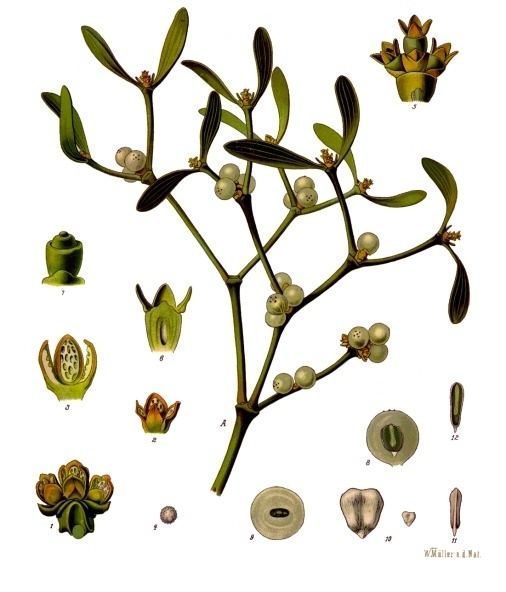
European mistletoe
Viscum album
Herbs & Roots. Western & European.
Also called Mistletoe, Common mistletoe, Golden bough
Spanish: Muérdago
Berries are toxic; never eatA plant that grows on trees, whose berries are poisonous, and whose extract is injected in some European cancer clinics.
Did you know? Mistletoe is a parasite that grows on trees. Birds spread its seeds by wiping sticky seeds off their beaks onto branches.
What it may help, and how strong the proof is
- Colds, flu & immunity. Injected extracts are used in some European cancer clinics to support the immune system. A Cochrane review found the trial data too thin to confirm any survival, quality-of-life, or tumor benefit.Early proof
- Blood pressure. Traditionally used to lower blood pressure. No good human trials support this, and too much can cause dangerously low pressure.Not supported
- Nerve health. Old folk use for epilepsy. No good evidence supports it, and poisoning can cause seizures.Not supported
Parts of the body
Traditional use
Pliny the Elder wrote about mistletoe as a remedy in ancient Rome. Later European folk healers used it for epilepsy and high blood pressure.
How it is classified
- Herbal actions
- Immune balancer, Hypotensive. Energy: neutral.
How people take it
Doctors in some European countries inject prescription extracts under the skin, usually several times a week, as an add-on to cancer care. Home use is not recommended.
Tincture and decoction.
Where to get it
Grows on apple, poplar, pine, and other trees across Europe and western Asia. Clinics use commercial extracts, and home products are sold as tinctures. Holiday mistletoe sold in North America is a different species with poisonous berries too, and Chinese mistletoe (sang ji sheng) is another plant used in Chinese medicine.
Be careful
The berries, leaves, and stems are poisonous. Eating berries can cause vomiting, diarrhea, slow heartbeat, low blood pressure, and seizures, and children who eat them need urgent medical care. Injections can cause fever and local swelling, and rarely serious allergic reactions.
Avoid if: pregnancy; breastfeeding; children under 12; low blood pressure; heart disease.
Mixing with other things
- Use cautionBlood pressure medicine (lisinopril, amlodipine, losartan)
May lower blood pressure, which could add to blood pressure medicines.
- Use cautionHeart rhythm medicine (digoxin, amiodarone)
Mistletoe poisoning can slow the heart, so heart medicines may add to this risk.
- Use cautionImmune-suppressing medicine (transplant drugs, some arthritis drugs)
Stimulates the immune system in theory, so it may work against immune-suppressing drugs.
Adds up with others that may lower blood pressure: , , , , , , , , , , , , , and 12 more.
The honest take
The berries, leaves, and stems of European mistletoe are poisonous, and home use is not safe. Injected extracts are used in some European cancer care, but the trials are small and mixed, and they do not prove that mistletoe cures cancer. Claims that it lowers blood pressure or helps epilepsy have no good human proof.