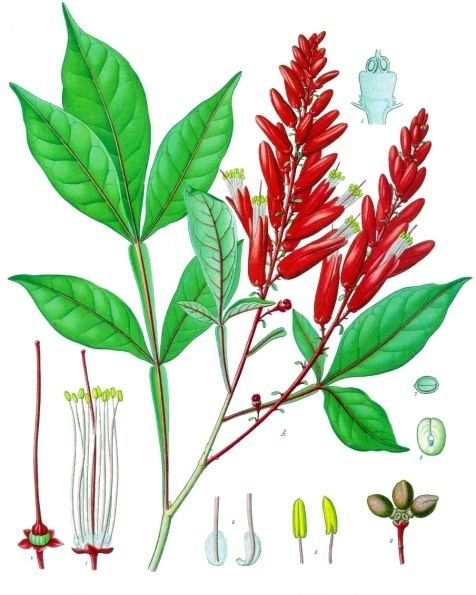
Hombre grande
Quassia amara
Herbs & Roots. Dr. Sebi's list and Latin American & Amazon.
Also called Bitterwood, Quassia, Kwasibita
Spanish: Cuasia
Possibly unsafe at high dosesA tropical tree whose very bitter wood is used as a bitter tonic, a fever remedy and a natural insect killer.
Did you know? The genus is named after Graman Quassi, an African healer in Suriname who used the bitter wood against fevers.
What it may help, and how strong the proof is
- Digestion & gut health. Used as a bitter to stir up appetite and digestion. No human trials were found.Traditional proof
- Fever. Used for fevers for generations. Only lab and rodent studies exist.Traditional proof
- Parasites & worms. Used against worms in tradition. Lab tests only.Traditional proof
Parts of the body
Traditional use
In Suriname, the Caribbean and Latin America, it has been used for fevers, worms and weak digestion. Old European bitter tonics also used it.
How it is classified
- Herbal actions
- Bitter, Anti-parasite. Energy: neutral.
How people take it
Bark or wood is steeped into a bitter tea or tincture. Typical amounts are not tested in people, so no safe dose is set.
Decoction and tincture.
Where to get it
Grows as a shrub or small tree in the Guiana Shield and northern Amazon. Sold as dried bark, tincture and bitters, and its quassin is used in some natural insect sprays.
Be careful
Rat studies link large doses to harm to male fertility. Tradition also uses it to end pregnancies. Large amounts can cause vomiting and diarrhea. Avoid it during pregnancy and breastfeeding.
Avoid if: pregnancy; breastfeeding.
Mixing with other things
No specific mixing notes on file. That doesn't prove it's safe with everything; ask a pharmacist about your full list.
The honest take
Quassia is a real bitter plant with some lab and rat evidence, but human trials are missing for fever and worms. Its safety at medicinal doses is rated possibly unsafe, so use caution, if at all.