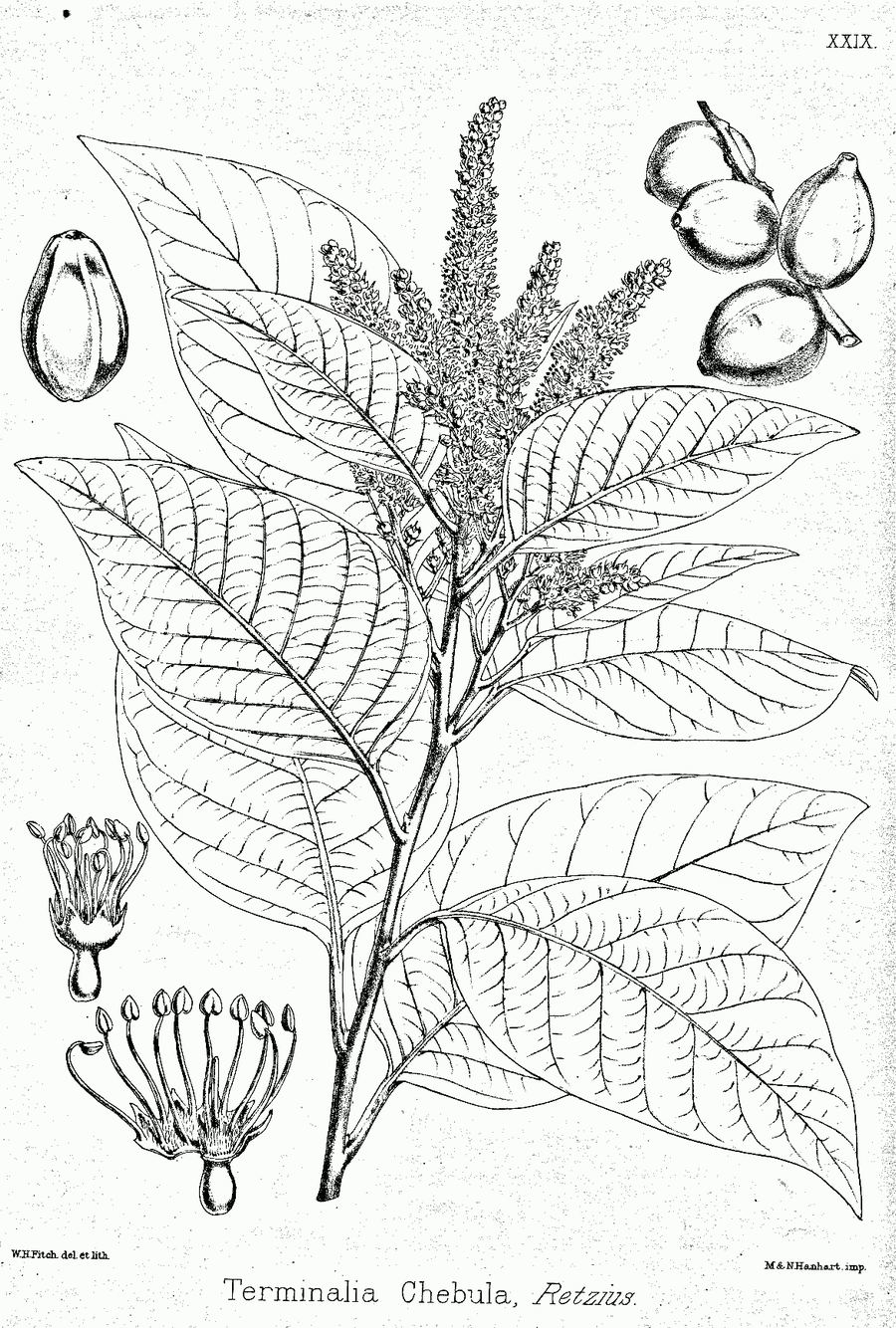
Haritaki
Terminalia chebula · 诃子
Herbs & Roots. Ayurveda and Chinese Medicine.
Also called Chebulic myrobalan, Black myrobalan, Harad, Hirda
Pinyin: Hē Zǐ
Spanish: Mirobálano
Sanskrit: हरीतकी (Haritaki)
Strong laxative; avoid in pregnancyHaritaki is a dried fruit from South Asia that is used in Ayurveda and Chinese medicine as a gentle laxative and digestive aid.
Did you know? Its dried fruit is rich in tannins, and myrobalan fruit has long been used to tan leather.
What it may help, and how strong the proof is
- Constipation. Small trials of triphala, a blend that includes haritaki, show more regular bowel movements. Trials of haritaki alone are few.Early proof
- Sore throat & cough. Traditional remedy for coughs and sore throat. Human trials are lacking.Traditional proof
- Infections. Tannins in the fruit show activity against some germs in lab studies. Human proof is lacking.Traditional proof
Parts of the body
Traditional use
In Ayurveda, haritaki is a rejuvenative (rasayana) and a mild laxative used for constipation and digestion. Chinese medicine uses the fruit for long-lasting diarrhea, chronic cough and a sore throat with hoarse voice.
How it is classified
- Herbal actions
- Laxative, Astringent, Carminative. Energy: warming.
- Ayurveda
- Tridoshic: balances all three doshas. Taste (rasa): sweet, sour, pungent, bitter, astringent. Energy (virya): heating. After digestion (vipaka): sweet. Rasayana (rejuvenative), Rechana (laxative), Pachana (digests toxins/ama).
- Chinese medicine
- 诃子 Astringe & stabilize. Nature: neutral. Flavour: sour, bitter, astringent. Enters the Lung and Large Intestine channels.
How people take it
Ayurvedic doses are about 1 to 3 grams of dried fruit powder a day, and it is best to start low because it can loosen stools quickly. Chinese herbal doses are about 3 to 10 grams as a decoction.
Powder, capsule and decoction.
Where to get it
A large tree native to South Asia, including India, Nepal and Myanmar, and found across the Himalayan region. Sold as dried whole fruit, powder, capsules and in triphala blends, and quality varies widely.
Be careful
Can cause cramps, loose stools and gas, especially at larger doses. Long-term laxative use can lead to low potassium and dehydration. Avoid in pregnancy, breastfeeding, and in young children unless a clinician advises it.
Avoid if: pregnancy; breastfeeding; children under 12.
Mixing with other things
- Works well together
Two of the three fruits in triphala, a classic Ayurvedic blend for digestion and regularity.
- Works well together
Part of triphala, the classic three-fruit Ayurvedic blend.
- Works well together
Yogaraja Guggulu, a classic Ayurvedic formula, combines guggul with triphala fruits such as haritaki.
- Use cautionWater pills (furosemide, hydrochlorothiazide)
The laxative effect adds to fluid and potassium loss from diuretics.
Found in these formulas
Triphala (Ayurveda)
The honest take
Haritaki has a long history in Ayurveda and Chinese medicine, and triphala shows some benefit for constipation in small trials. Haritaki alone has far less human research. Its longevity and detox claims are tradition, not proof, and products vary, so choose ones with third-party testing.