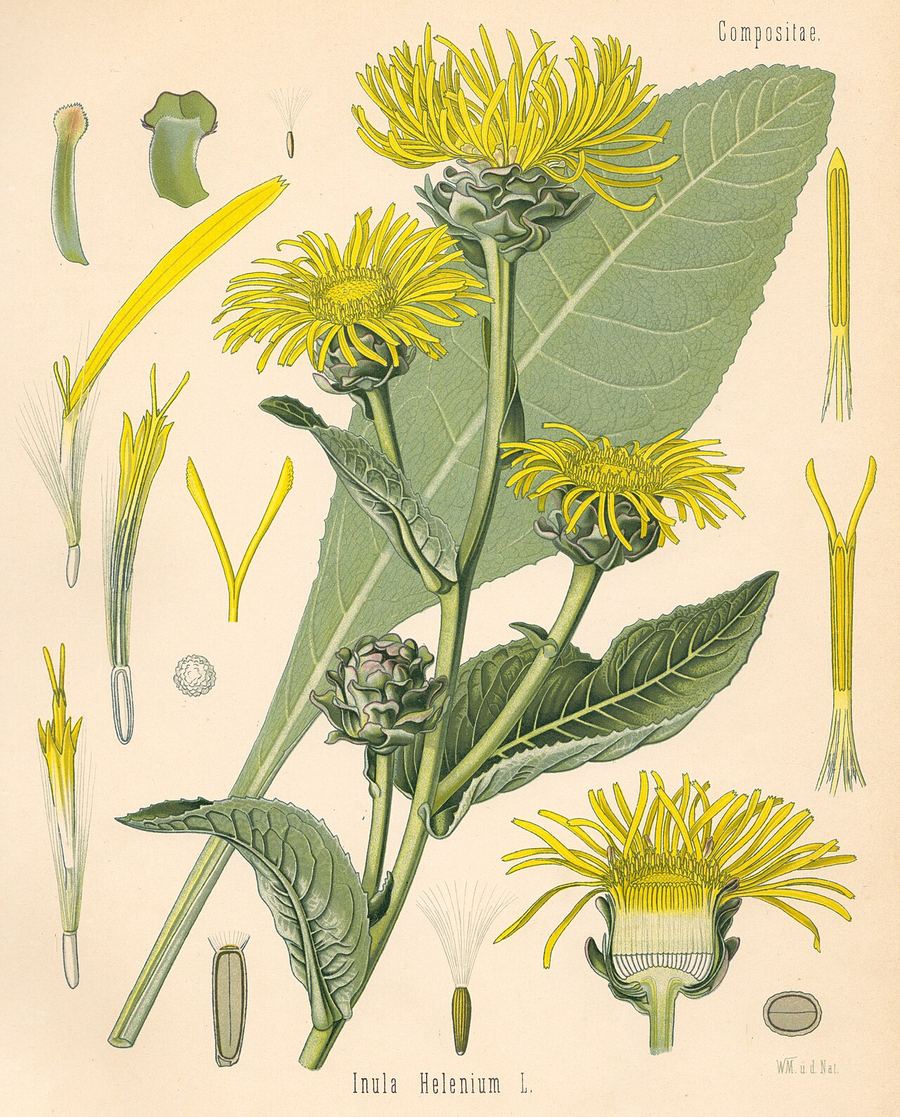
Elecampane
Inula helenium
Herbs & Roots. Western & European.
Also called Horseheal, Scabwort, Elfdock
Spanish: Énula campana
Allergy risk in ragweed familyA tall yellow-flowered herb whose root is used for coughs and digestion.
Did you know? Inulin, a fiber that feeds good gut bacteria, was first isolated from elecampane root, and its name comes from the plant's Latin genus, Inula.
What it may help, and how strong the proof is
- Breathing & asthma. Long used for bronchitis, coughs, and breathing trouble. Little or no modern human research exists.Traditional proof
- Digestion & gut health. Bitter root traditionally used to aid digestion. Human research is missing.Traditional proof
Parts of the body
Traditional use
Greek and Roman writers praised elecampane for coughs and chest problems. Medieval cooks candied the root as a sweet with digestive uses.
How it is classified
- Herbal actions
- Expectorant, Antimicrobial, Bitter. Energy: warming.
How people take it
Doses come from tradition, usually about 1 to 2 grams of dried root a day as tea, or a small amount of tincture. No trial-based dose is established.
Tincture, tea and syrup.
Where to get it
Grows in damp meadows and roadsides across Europe and Asia, and has spread to North America. Sold as dried root, tinctures, and syrups.
Be careful
Can cause allergy in people sensitive to daisies, ragweed, or chrysanthemums. Large doses may upset the stomach. Avoid it in pregnancy, since its safety there is not established.
Avoid if: ragweed allergy; pregnancy.
Mixing with other things
- Works well together
Often combined in old-style cough syrups and honeys.
- Works well together
Common in traditional cough teas.
Found in these formulas
Chest & breath tea (Western)
The honest take
Elecampane has a long history for coughs and digestion, but there are almost no modern human trials. Its inulin fiber is real, though its effects in this herb are not well studied. Be wary of strong claims about it.