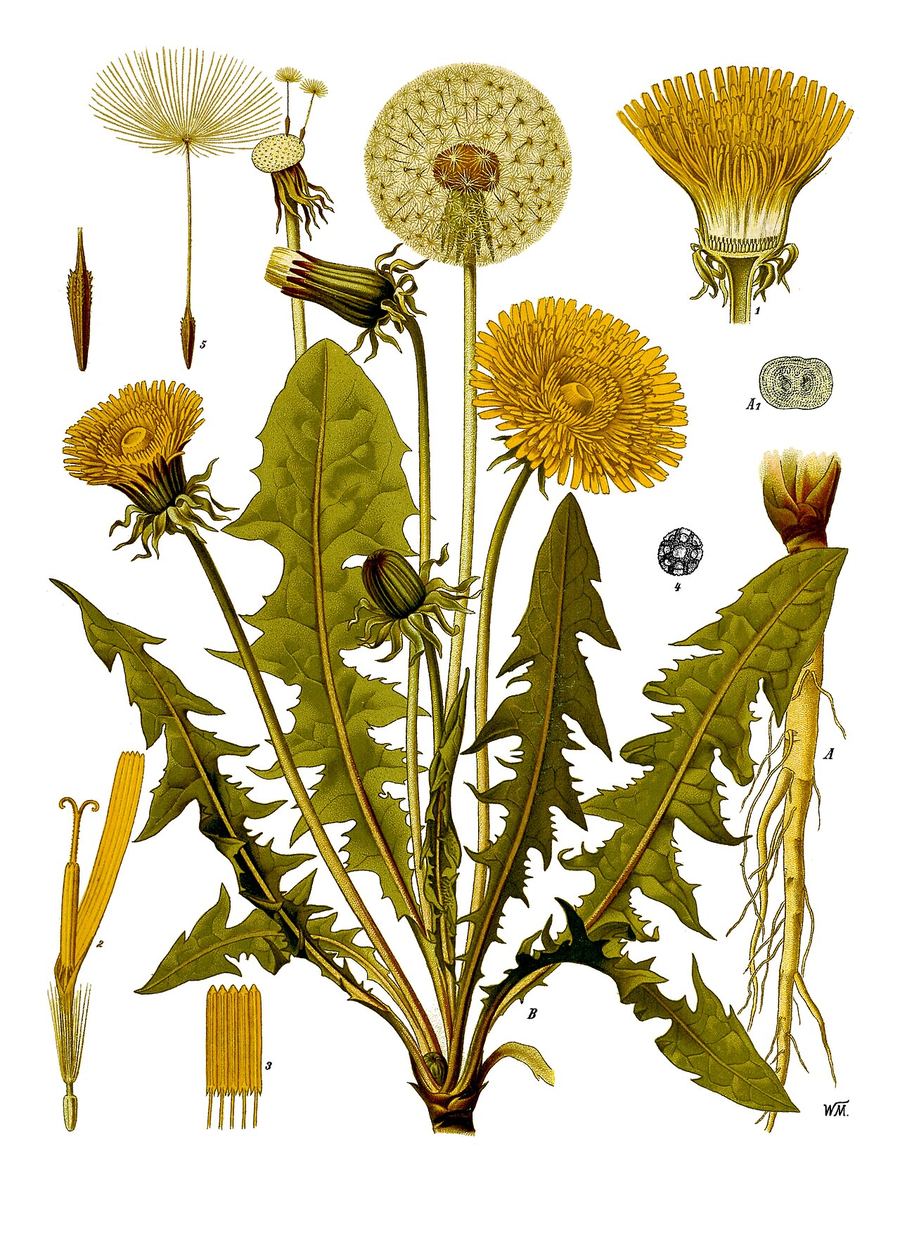
Dandelion
Taraxacum officinale · 蒲公英
Herbs & Roots. Western & European, Chinese Medicine and Dr. Sebi's list.
Also called Lion's tooth, Blowball, Pu gong ying
Pinyin: Pú Gōng Yīng
Spanish: Diente de león
Can add to water pillsDandelion is a common yellow weed whose leaves and roots are eaten as food and used in folk medicine as a mild water pill and liver tonic.
Did you know? The name dandelion comes from the French 'dent de lion,' meaning 'lion's tooth,' for the jagged shape of its leaves.
What it may help, and how strong the proof is
- Liver. The root is used for liver and gallbladder complaints, but the evidence is mostly lab and animal work.Traditional proof
- Kidneys, bladder & UTIs. The leaf is used as a folk water-loss herb, and studies are mostly in animals.Traditional proof
- Cleansing & detox. Often sold as a liver or blood detox, and there is no proof of that.Not supported
Parts of the body
Traditional use
European herbalists used dandelion root for liver and gallbladder complaints, and the leaf as a water-loss herb. In Chinese medicine, pu gong ying, often a related species called Taraxacum mongolicum, is used to clear heat and toxins, including breast abscesses and eye inflammation from liver heat.
How it is classified
- Herbal actions
- Diuretic, Bitter, Cholagogue, Hepatic. Energy: cooling.
- Chinese medicine
- 蒲公英 Clear heat. Nature: cold. Flavour: bitter, sweet. Enters the Liver and Stomach channels.
How people take it
Leaves are eaten in salads or steeped as tea, and roots are roasted, steeped, or taken as tincture or capsules. No standard dose is proven, and product strength varies widely.
Tea, decoction, tincture, capsule and food.
Where to get it
Grows as a common weed across Europe, Asia, and North America. Sold as dried leaf or root, tea bags, tinctures, and capsules, and wild plants from roadsides can carry pollution.
Be careful
Can cause allergic reactions, especially in people sensitive to ragweed or daisy-family plants. The leaf can make you pass more urine, which may lower potassium with some water pills. Avoid it if you have gallstones or a blocked bile duct, because it may increase bile flow.
Avoid if: ragweed allergy; gallstones; kidney disease.
Mixing with other things
- Works well together
Both appear in old spring tonic and blood-cleansing teas.
- Works well together
Traditional spring tonic blends often combine the two.
- Works well together
Common together in liver-support teas and products.
- Works well together
Both are old spring tonic herbs.
- Works well together
Both are bitter herbs used for digestion in European tradition.
- Works well together
Both are bitter herbs used for digestion and liver support in European tradition.
- Works well together
Dandelion leaf and root are common partners in kidney and fluid-balance teas.
- Works well together
Both are common in European spring cleansing teas.
- Works well together
Both are early spring greens used in traditional tonic teas and salads.
- Works well together
Both are bitter leaves used in liver and digestion teas.
- Use cautionWater pills (furosemide, hydrochlorothiazide)
Can add to water pills and may lower potassium.
- Use cautionLithium (for bipolar disorder)
Diuretic herbs may change lithium levels in the blood, so check with a doctor first.
Found in these formulas
Digestive bitters (Western)
The honest take
Dandelion greens are a nutritious food, and the root is a common tea ingredient. There is no good proof that dandelion flushes toxins from the liver or cleanses the blood. Most of the science is lab and animal work, so claims about liver or kidney health are ahead of the evidence.