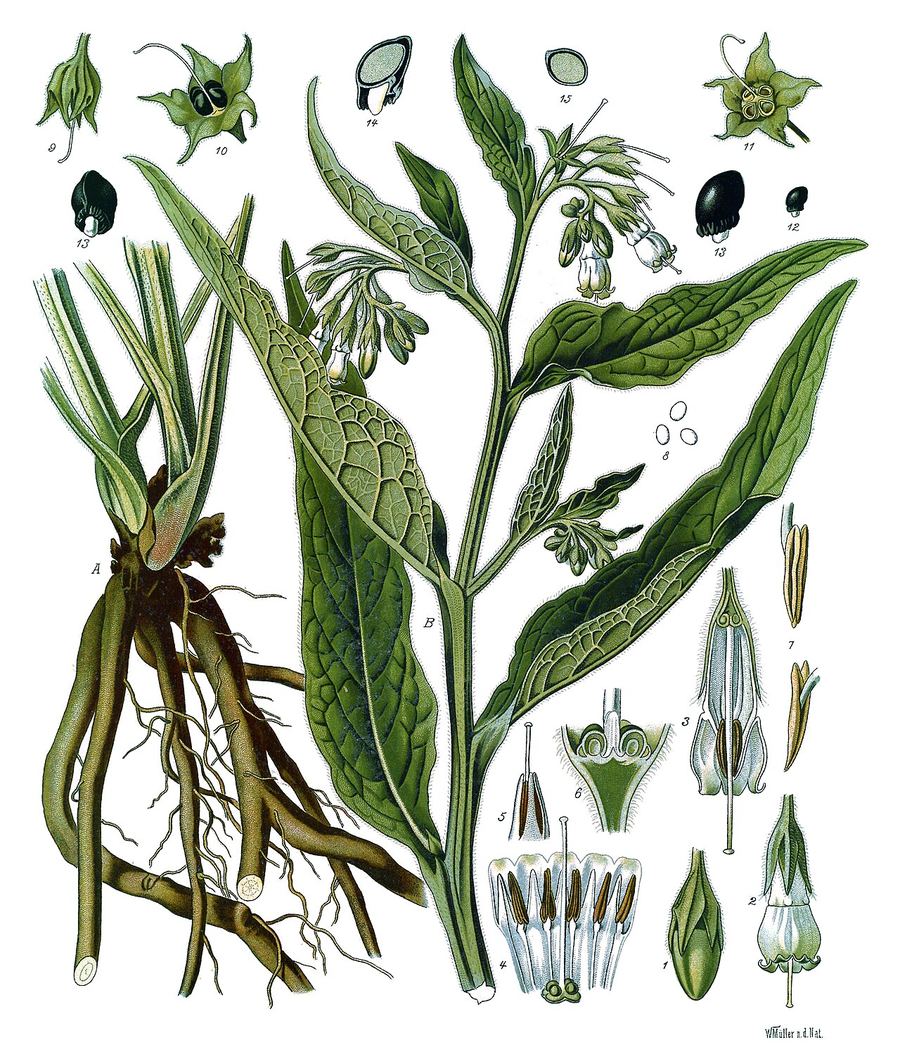
Comfrey
Symphytum officinale
Herbs & Roots. Western & European.
Also called Knitbone, Bruisewort, Blackwort
Spanish: Consuelda
Liver toxin if swallowedComfrey is a hairy plant whose leaves are used in creams for sprains and bruises, but swallowing it is dangerous.
Did you know? Comfrey's Latin name, Symphytum, comes from Greek words meaning 'to grow together,' linked to the old belief that it helps bones knit.
What it may help, and how strong the proof is
- Pain & headaches. Small trials of comfrey cream on sprains show modest pain relief.Early proof
- Wounds, burns & bites. Used on bruises and wounds, mostly from tradition.Traditional proof
- Bones. Called knitbone because it was thought to heal broken bones, and that idea is not proven.Not supported
Parts of the body
Traditional use
European folk herbalists used comfrey on broken bones, bruises, and sprains, which is why it has names like 'knitbone' and 'bruisewort.'
How it is classified
- Herbal actions
- Vulnerary, Demulcent, Anti-inflammatory. Energy: cooling.
How people take it
Only as a short-term cream, ointment, or gel on intact skin, for sprains or bruises. Never take it by mouth. Longer use needs a doctor's advice.
Topical and gel.
Where to get it
Grows in damp meadows and along streams across Europe and Asia, and is grown in gardens. Sold as creams, ointments, and gels. Oral products are banned or restricted in several countries.
Be careful
Oral comfrey can cause serious liver damage, including fatal cases. Its toxic compounds can also build up through the skin, so avoid long use and broken skin. Do not use it during pregnancy or breastfeeding.
Avoid if: liver disease; pregnancy; breastfeeding; open wounds.
Mixing with other things
- Works well together
Both are common in folk topical salves.
- Works well together
Both are used together in folk topical salves.
- Works well together
Both are used on bruises and sprains.
The honest take
Comfrey creams have a few small trials for sprains with modest results. Its internal use is dangerous because it contains liver-toxic alkaloids. Claims that it heals bones or wounds from the inside are unsafe and unproven.