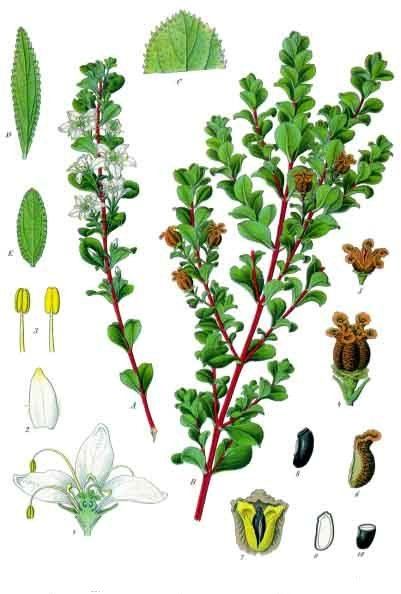
Buchu
Agathosma betulina
Herbs & Roots. African.
Also called Round buchu, Bookoo
Liver risk at high dosesBuchu is a small South African shrub whose strong-smelling leaves are used in tea and tinctures, mainly for urinary complaints.
Did you know? Buchu leaves give off a strong smell that is often described as black currant or mint.
What it may help, and how strong the proof is
- Kidneys, bladder & UTIs. Long traditional use for bladder and urinary symptoms. Human trials are few, and regulatory reviews have not endorsed it for urinary infections.Traditional proof
- Infections. Lab tests show some germ-killing activity. Human proof is limited.Traditional proof
Parts of the body
Traditional use
The Khoikhoi people of South Africa used buchu for many ailments long before European settlers arrived. European settlers later took up the plant for bladder and digestive complaints.
How it is classified
- Herbal actions
- Diuretic, Antimicrobial. Energy: neutral.
How people take it
Traditionally, a small amount of dried leaf is steeped as tea. There are no proven doses from good human trials, so follow label directions and never swallow essential oil.
Tea, tincture and capsule.
Where to get it
Grows wild in the dry shrublands (fynbos) of South Africa's Western Cape. Some supply is wild-harvested, and it is sold as dried leaf, tea, tinctures, and capsules.
Be careful
Buchu leaves contain pulegone, a compound that can harm the liver and kidneys at high or long-term doses. The essential oil is the most concentrated form and should not be swallowed. Avoid buchu if you have kidney inflammation, and check with a doctor before using it with water pills.
Avoid if: pregnancy; kidney disease; liver disease.
Mixing with other things
- Works well together
Both are old urinary herbs that often appear together in traditional blends.
- Works well together
Juniper berry is another traditional urinary herb with a similar history.
- Use cautionWater pills (furosemide, hydrochlorothiazide)
Buchu may make you pass more urine. Taken with water pills, it can cause dehydration or low salt levels.
The honest take
Buchu has a long history of use, but modern proof is weak. Most research is lab work and reports of harm, and the leaves contain pulegone (a compound that can injure the liver). The essential oil is not safe to swallow.