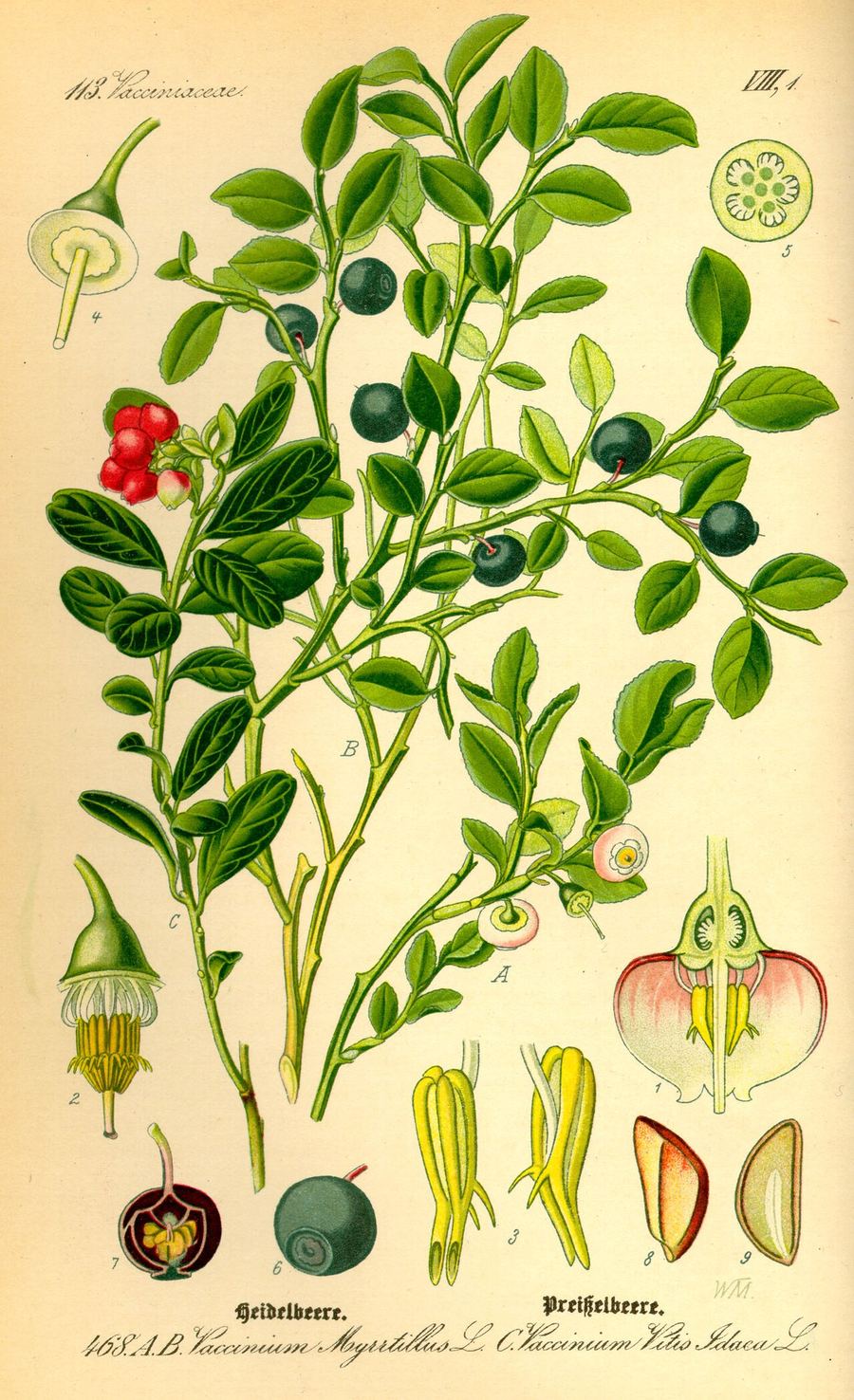
Bilberry
Vaccinium myrtillus
Fruits. Western & European.
Also called Whortleberry, European blueberry, Blaeberry
Spanish: Mirtilo
Can add to blood thinnersA small dark-blue wild berry, eaten fresh or sold as extract for eye, vein, and blood sugar claims.
Did you know? A widely repeated story says World War II RAF pilots ate bilberry jam to see better at night. There is no solid proof it worked.
What it may help, and how strong the proof is
- Blood sugar. One tiny trial of 8 men with type 2 diabetes found bilberry extract blunted the blood sugar rise after a sugar drink. It tested one dose, so longer-term effects are unknown.Early proof
- Digestion & gut health. Dried berries were used for diarrhea because of their tannins. Traditional, with few human trials.Traditional proof
- Eyes & vision. Promoted for night vision. Small trials in healthy people did not clearly show better night vision.Not supported
Parts of the body
Traditional use
Europeans ate the berries and used them for diarrhea. Leaves were used for blood sugar and vein problems, and the berries for vision.
How it is classified
- Herbal actions
- Antioxidant, Astringent. Energy: neutral.
How people take it
Berries are eaten fresh or dried. Extracts come in many strengths, and no standard dose has been proven.
Food, tea, capsule and tincture.
Where to get it
Bilberry grows wild in northern and mountain forests across Europe and Asia, and the berries ripen in summer. Fresh or frozen berries are sold, and extract is sold as capsules.
Be careful
The berries are safe as food. Extracts may lower blood sugar and may add to blood thinners, so check with a doctor if you take either. Leaf teas are not advised for long-term use because the leaves contain arbutin, which the body converts to a hydroquinone compound.
Avoid if: pregnancy; diabetes medicines; bleeding disorders.
Mixing with other things
- Works well together
Same genus, and both are eaten fresh and dried in the same ways.
- Works well together
Both are sold for eye and circulation health. Human proof is limited for each.
- Works well together
Both are polyphenol-rich extracts sold for circulation and eye health.
- Works well together
Both are polyphenol-rich extracts sold for circulation and eye health.
- Use cautionBlood thinners (warfarin, Eliquis, Xarelto, Plavix, daily aspirin)
Bilberry may have mild blood-thinning effects and may add to anticoagulants.
- Use cautionDiabetes medicine (metformin, insulin, glipizide, Ozempic)
It may lower blood sugar and add to diabetes medicines, causing lows.
Adds up with others that may slow blood clotting: , , , , , , , , , , , , , and 40 more.
Adds up with others that may lower blood sugar: , , , , , , , , , , , , , and 39 more.
The honest take
Bilberry berries are a healthy fruit. The night vision story is a myth with no proof, and the eye claims are weak. Blood sugar claims rest on one tiny single-dose trial, and vein claims have little human proof, so do not rely on bilberry extract to manage diabetes.