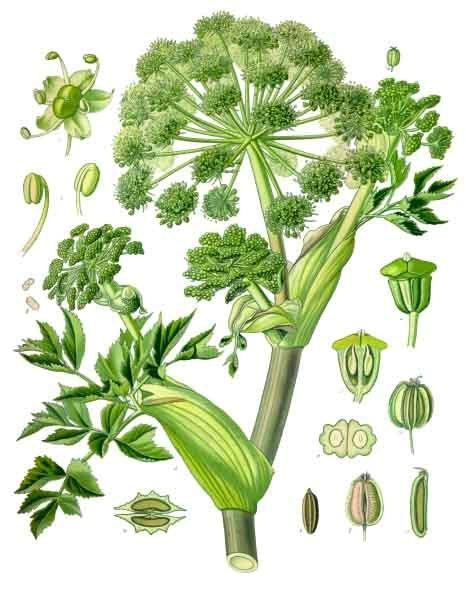
Angelica
Angelica archangelica
Herbs & Roots. Western & European.
Also called Garden angelica, Norwegian angelica, Holy ghost
Spanish: Angélica
Sun sensitivity; avoid in pregnancyA tall European herb whose root is used for digestion and whose candied stalks decorate sweets.
Did you know? Bright green candied angelica stalks decorate many cakes and sweets, and the root is a common flavor in gin.
What it may help, and how strong the proof is
- Digestion & gut health. Used for bloating, gas, and loss of appetite. Few human studies exist.Traditional proof
- Women's health. Used for period cramps and sluggish periods. Mostly tradition, and it should be avoided in pregnancy.Traditional proof
Parts of the body
Traditional use
Medieval herbalists used angelica for colds, plague, and digestion. A legend says an angel revealed its healing power, which is how it got its name.
How it is classified
- Herbal actions
- Carminative, Bitter, Antispasmodic. Energy: warming.
How people take it
Tea is usually 1 to 2 grams of dried root a day. Candied stalks are eaten in small amounts as food. No trial-based doses exist.
Tea, tincture and food.
Where to get it
Grows in damp, cool areas of northern Europe and is widely cultivated. Sold as dried root, tea, tinctures, and candied stalks.
Be careful
Contains furanocoumarins, which make skin sensitive to sunlight and can cause rash or sunburn. Avoid it in pregnancy, since it may stimulate the uterus. Do not confuse it with Chinese dong quai, which is a different species.
Avoid if: pregnancy; sun sensitivity; bleeding disorders.
Mixing with other things
- Works well together
Both are used in bitter liqueurs and digestive blends.
- Works well together
A classic botanical pairing in bitters and liqueurs.
- Works well together
Both are used in digestive teas for gas and bloating.
- Use cautionBlood thinners (warfarin, Eliquis, Xarelto, Plavix, daily aspirin)
Contains coumarins, which may add to bleeding risk with warfarin and similar drugs.
Adds up with others that may slow blood clotting: , , , , , , , , , , , , , and 40 more.
Found in these formulas
Digestive bitters (Western)
The honest take
Angelica is a traditional digestive herb and a flavor in gin and sweets. Human research is missing, so its digestive benefits rest on tradition. Its sun sensitivity and possible interaction with blood thinners are real, so use it with care.