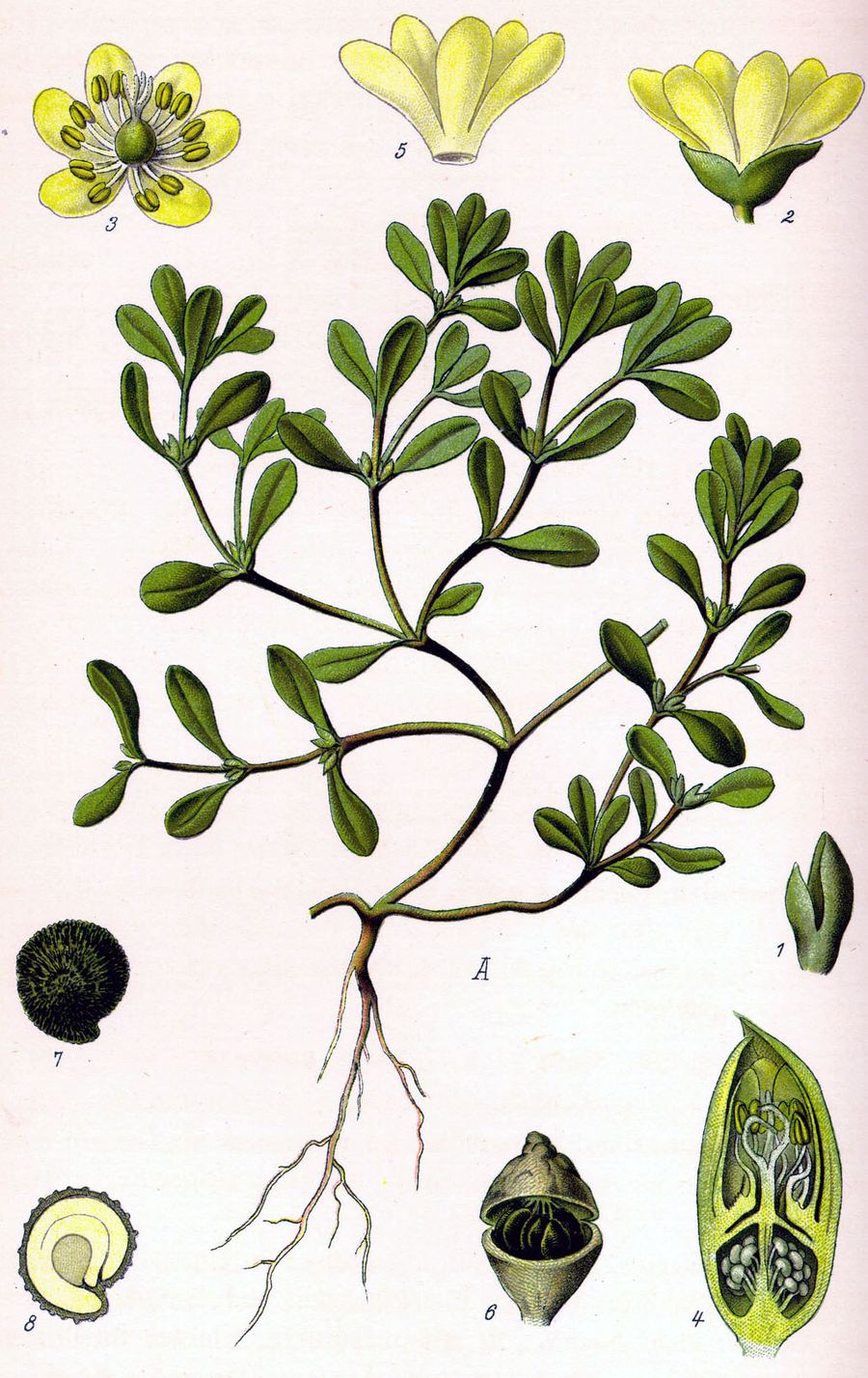
Purslane
Portulaca oleracea · 马齿苋
Vegetables. Dr. Sebi's list, Latin American & Amazon and Chinese Medicine.
Also called Verdolaga, Little hogweed, Pusley
Pinyin: Mǎ Chǐ Xiàn
Spanish: Verdolaga
High in oxalatesA juicy weed eaten as a salad green in many countries. For a vegetable, it is a notable source of omega-3 fat.
Did you know? Purslane is one of the richest leafy plant sources of omega-3 fat (ALA), yet many people still call it a weed.
What it may help, and how strong the proof is
- Cholesterol. Animal and small human studies hint at lower cholesterol. More work is needed.Traditional proof
- Blood sugar. Some animal and small human studies show lower blood sugar. The evidence is weak.Traditional proof
- Digestion & gut health. Used for dysentery in Chinese medicine. No good human trials exist.Traditional proof
Parts of the body
Heart & vessels, Liver, Pancreas & blood sugar, Gut & intestines, Stomach
Traditional use
In Chinese medicine it has been used to clear heat and ease dysentery. In Latin America it is a common cooking green.
How it is classified
- Herbal actions
- Nutritive, Antioxidant. Energy: cooling.
- Chinese medicine
- 马齿苋 Clear heat. Nature: cold. Flavour: sour. Enters the Liver and Large Intestine channels.
How people take it
Eaten raw in salads, cooked as a vegetable or added to soups. Studies use it as food, so no medicinal dose is set.
Food, tea and juice.
Where to get it
A common weed worldwide, and grown as a vegetable in Mexico and Asia. Sold fresh in markets and as seed. Wild plants can pick up lead from soil and roadsides.
Be careful
High in oxalates, which can add to the risk of kidney stones. Wild plants can take up lead from soil and car exhaust. Ask a doctor first if you have kidney stones.
Avoid if: kidney stones; kidney disease.
Mixing with other things
No specific mixing notes on file. That doesn't prove it's safe with everything; ask a pharmacist about your full list.
The honest take
Purslane is a real food with some omega-3 fat and vitamins, and it is safe in normal amounts. Claims that it lowers blood sugar or cholesterol rest on small or animal studies. Its human benefits are unproven.