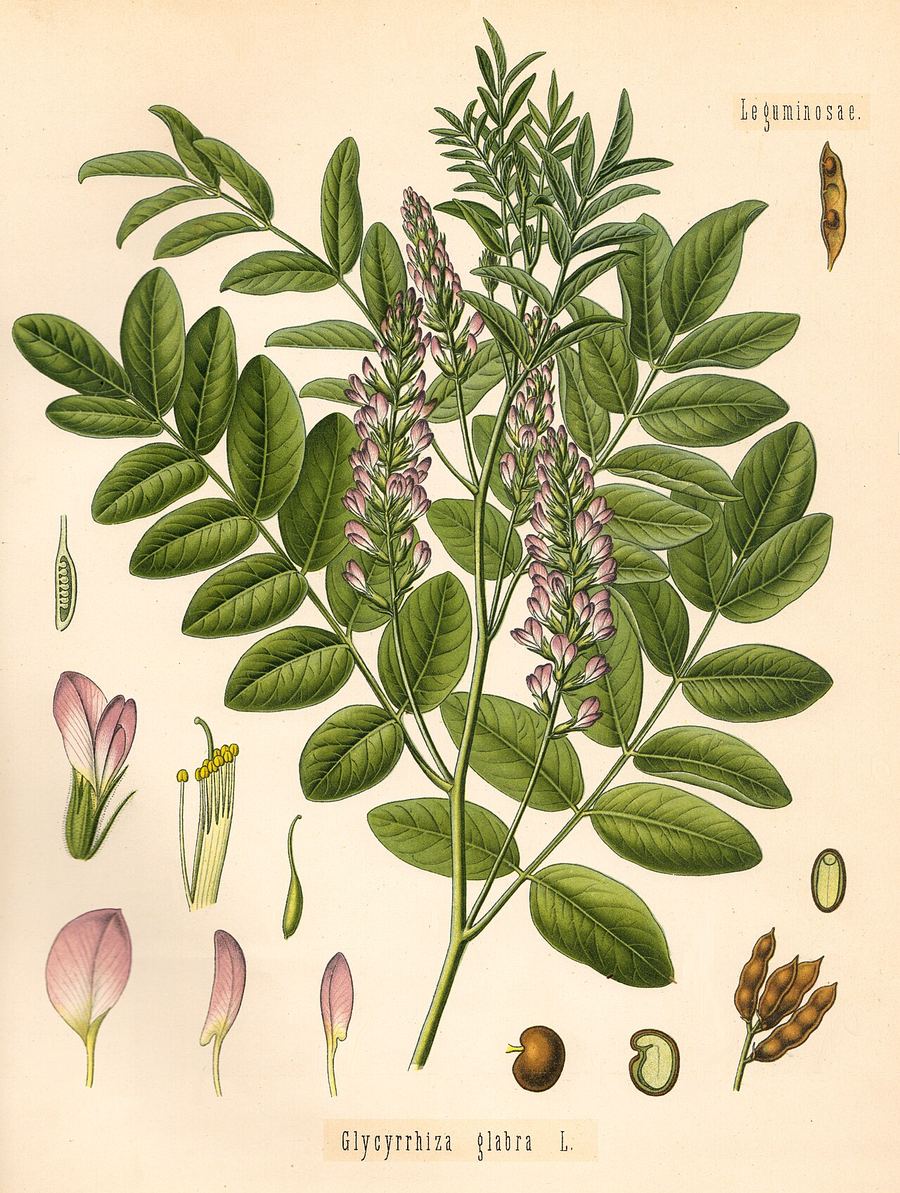
Licorice root
Glycyrrhiza glabra · 甘草
Herbs & Roots. Ayurveda, Chinese Medicine and Western & European.
Also called Liquorice, Sweet root, Yashtimadhu, Gan cao
Pinyin: Gān Cǎo
Spanish: Regaliz
Sanskrit: यष्टिमधु (Yashtimadhu)
Raises blood pressure, lowers potassiumLicorice root is a sweet root used in Ayurveda, Chinese and Western herbal medicine for sore throat and stomach upset, but high doses can raise blood pressure.
Did you know? Glycyrrhizin, the sweet compound in licorice root, is about 50 times sweeter than table sugar.
What it may help, and how strong the proof is
- Sore throat & cough. Some small trials show licorice lozenges ease sore throat. Results are mixed, and the trials are small.Early proof
- Digestion & gut health. Small trials of deglycyrrhizinated licorice (DGL) report relief from heartburn and stomach upset. Results are mixed.Early proof
- Inflammation. Lab studies show anti-inflammatory and antiviral effects. Human evidence is thin.Traditional proof
Parts of the body
Mouth & throat, Lungs, Gut & intestines, Stomach, Immune system, Joints
Traditional use
Ayurveda calls it yashtimadhu, a rejuvenative that is used for the voice and skin. Chinese medicine calls it gan cao and adds it to many formulas to balance the other herbs.
How it is classified
- Herbal actions
- Demulcent, Expectorant, Antispasmodic. Energy: cooling.
- Ayurveda
- Calms Vata and Pitta. Can raise Kapha. Taste (rasa): sweet. Energy (virya): cooling. After digestion (vipaka): sweet. Rasayana (rejuvenative), Varnya (complexion), Kanthya (voice and throat).
- Chinese medicine
- 甘草 Tonify Qi. Nature: neutral. Flavour: sweet. Enters the Heart, Lung, Spleen and Stomach channels.
How people take it
Licorice tea is usually one to two cups a day for short periods. Keep glycyrrhizin intake well under about 100 mg a day, and avoid long-term daily use.
Tea, lozenge and tablet.
Where to get it
Grows wild and is cultivated in southern Europe, the Middle East, and Central and East Asia. Sold as dried root, tea, lozenges, extracts and DGL tablets, and much of the 'licorice' candy sold in the U.S. is flavored with anise instead.
Be careful
High or regular intake can raise blood pressure, lower potassium, and cause fluid retention, swelling, weakness and heart rhythm problems. The risk is higher with age, high blood pressure, kidney disease or heart disease. Avoid it in pregnancy, and use DGL if you want the stomach benefit without the blood pressure risk.
Avoid if: pregnancy; high blood pressure; heart disease; kidney disease; low potassium.
Mixing with other things
- Works well together
A common throat blend partner, and licorice also soothes the throat.
- Works well together
A common pairing in throat lozenges and soothing teas.
- Works well together
Part of Si Jun Zi Tang (Four Gentlemen Decoction), a classic TCM tonic formula.
- Works well together
Part of Si Jun Zi Tang (Four Gentlemen Decoction).
- Works well together
Part of Si Jun Zi Tang (Four Gentlemen Decoction).
- Works well together
Licorice soothes the throat and is often combined with cough herbs.
- Works well together
Jujube and licorice (gan cao) are paired in Gan Mai Da Zao Tang (Licorice, Wheat and Jujube Decoction), used in tradition for restlessness and low mood.
- Works well together
Bai shao and licorice form Shao Yao Gan Cao Tang (Peony and Licorice Decoction), used for cramps in tradition and in Japanese Kampo.
- Works well together
Licorice is also in Ge Gen Tang to balance the formula.
- Works well together
Also in Ma Huang Tang, where licorice is added to moderate the formula.
- Don't mixBlood pressure medicine (lisinopril, amlodipine, losartan)
Raises blood pressure and works against blood pressure medicines.
- Don't mixHeart rhythm medicine (digoxin, amiodarone)
Low potassium from licorice raises the risk of dangerous heart rhythms with heart medicines such as digoxin.
- Use cautionWater pills (furosemide, hydrochlorothiazide)
Can lower potassium, adding to the effect of water pills.
- Use cautionImmune-suppressing medicine (transplant drugs, some arthritis drugs)
Can add to potassium loss and fluid retention with steroid medicines.
- Use caution
Licorice also lowers potassium, so using both adds risk.
Found in these formulas
Four Gentlemen (TCM), Free & Easy Wanderer (TCM), Honeysuckle & Forsythia (TCM), Restore the Spleen (TCM), Sour Jujube Decoction (TCM), Chest & breath tea (Western)
The honest take
Licorice has real but small trial evidence for sore throat and stomach upset. The bigger issue is safety, since regular use of candy, tea or extract can raise blood pressure and lower potassium, sometimes seriously. Choose DGL for stomach use, and limit whole licorice to short periods.