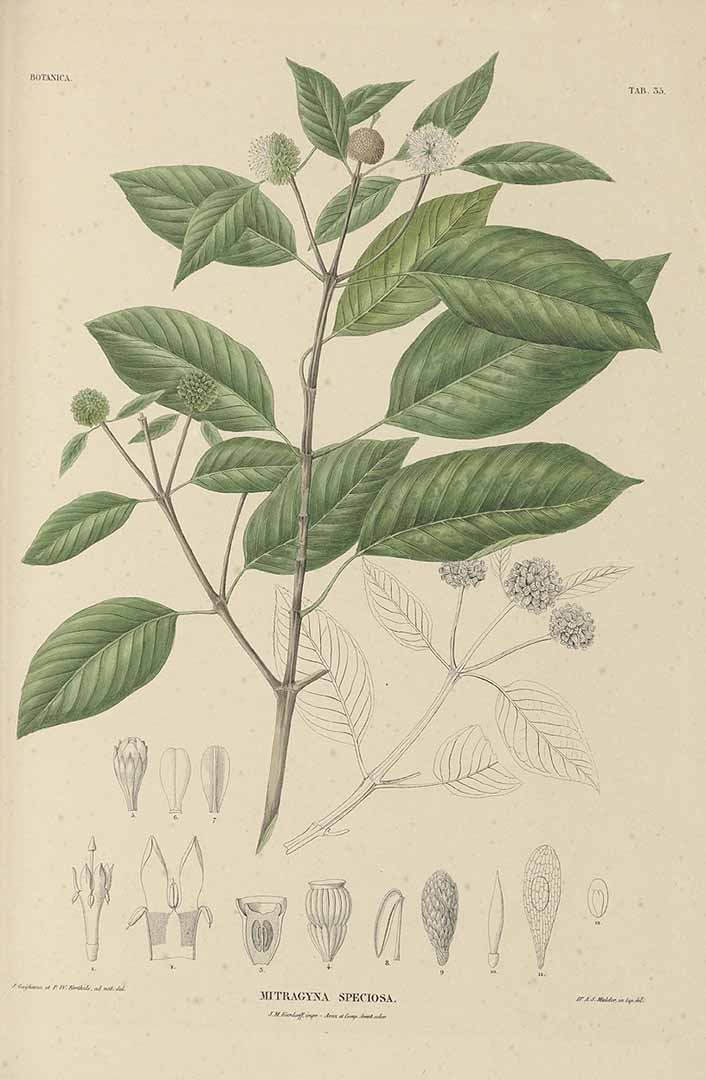
Kratom
Mitragyna speciosa
Herbs & Roots. Folk & home remedies and Modern nutrition.
Also called Ketum, Krathom, Kratom leaf
Addiction and overdose riskA leaf from Southeast Asia used for pain and energy, but it is habit-forming and banned or restricted in many places.
Did you know? Kratom is related to coffee. Both belong to the same plant family, Rubiaceae.
What it may help, and how strong the proof is
- Pain & headaches. Used for pain, and its compounds act on opioid receptors. Human studies are few and small.Traditional proof
- Energy & tiredness. Used at low doses for energy and focus. Human studies are small and short.Traditional proof
- Low mood. Sold for anxiety, depression and opioid withdrawal. No good evidence supports these uses, and kratom can cause dependence.Not supported
Parts of the body
Traditional use
Workers in Thailand, Malaysia and Indonesia chewed or brewed kratom leaves to fight tiredness and ease pain. Its use there has long been folk custom.
How it is classified
How people take it
Leaves are chewed, brewed as tea, or taken as powder or capsules. Strength varies widely, and many products are not tested.
Tea, capsule and powder.
Where to get it
Grows on trees in Southeast Asia, especially Thailand, Malaysia and Indonesia. Sold as dried leaf powder, capsules, extracts and concentrated products. Concentrated 7-OH products carry the highest risk, and US regulators have moved to restrict them.
Be careful
Can cause nausea, constipation, weight loss, itching and dependence. Withdrawal can be hard. Serious harms, including seizures, liver injury and deaths, have been reported, often when kratom is combined with other drugs or taken in high doses.
Avoid if: pregnancy; breastfeeding; liver disease; opioid use; seizures.
Mixing with other things
- Don't mixSleep or anxiety medicine (Ambien, Xanax, Ativan)
Adds to sedation and slowed breathing with sleep medicines and benzodiazepines.
- Don't mixAlcohol (beer, wine, spirits)
Alcohol with kratom adds to sedation and overdose risk.
Adds up with others that can make you drowsy: , , , , , , , , , , , , , and 14 more.
The honest take
Kratom has been used for generations, but good human evidence for pain, energy or mood is missing. Its compounds act on opioid receptors, which can cause dependence and serious harm. Laws change quickly, and several US states and federal agencies have moved to ban or restrict it, especially concentrated 7-OH products.