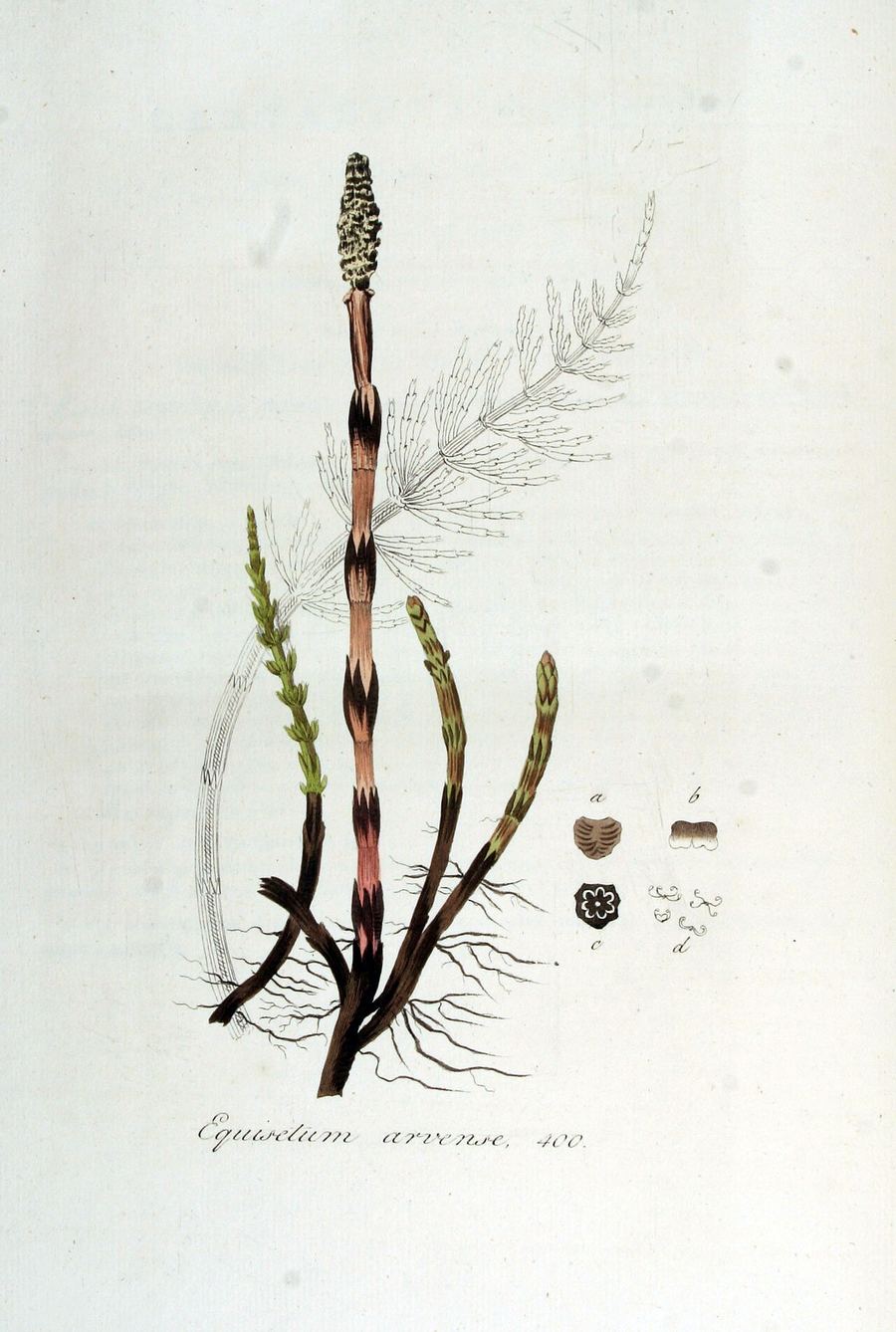
Horsetail
Equisetum arvense
Herbs & Roots. Western & European.
Also called Field horsetail, Scouring rush, Bottlebrush
Spanish: Cola de caballo
Can deplete vitamin B1A jointed green stem used as a tea for urinary support and for its silica content.
Did you know? Horsetails are living relics, a group about 300 million years old, and some of its ancient relatives grew into trees more than 10 meters tall.
What it may help, and how strong the proof is
- Kidneys, bladder & UTIs. Used as a diuretic for bladder and urinary complaints. Mostly tradition and small lab studies.Traditional proof
- Bones. Used for bone health and broken bones because of its silica. No good human trials show that horsetail builds bone.Traditional proof
- Wounds, burns & bites. Used to stop minor bleeding and help cuts heal. Traditional, with little testing.Traditional proof
Parts of the body
Traditional use
European herbalists used horsetail to stop bleeding, help wounds heal, and support broken bones. It was also a common diuretic for bladder and kidney complaints.
How it is classified
- Herbal actions
- Diuretic, Astringent. Energy: neutral.
How people take it
Traditional tea is made from dried stems, usually as a short infusion. Long daily use is not advised. No standard human dose has been set.
Tea, decoction, capsule and tincture.
Where to get it
Horsetail grows wild in wet ground and along roadsides across the Northern Hemisphere, and it is sold dried, as tea, and as extract. Look for products labeled thiaminase-free, and make sure the species is correct, since marsh horsetail is more toxic.
Be careful
Long-term use can lower vitamin B1 (thiamine), because the plant contains thiaminase, an enzyme that breaks thiamine down. Heavy use may also cause potassium loss and low sodium. Avoid it in pregnancy, while breastfeeding, and with kidney disease.
Avoid if: pregnancy; breastfeeding; kidney disease; heavy alcohol use.
Mixing with other things
- Works well together
Often blended with horsetail and other diuretic herbs for urinary tea.
- Works well together
Common in urinary tea blends with other diuretic herbs.
- Works well together
Juniper and horsetail appear together in European kidney and fluid-balance teas.
- Works well together
Both are urinary tea herbs used together in traditional blends.
- Works well together
Horsetail is a plant source of silica, though it has its own cautions.
- Use cautionWater pills (furosemide, hydrochlorothiazide)
Horsetail is a diuretic and can cause potassium loss. Combined with water pills, the risk of low potassium goes up.
- Use cautionAlcohol (beer, wine, spirits)
Alcohol also lowers thiamine (vitamin B1). Using both raises the risk of thiamine deficiency.
The honest take
Horsetail's old uses for bleeding and bone healing have little human proof. Its silica is not shown to build bone when taken as this herb. The real concerns are long-term thiaminase effects and potassium loss, so keep use short and skip it in pregnancy.