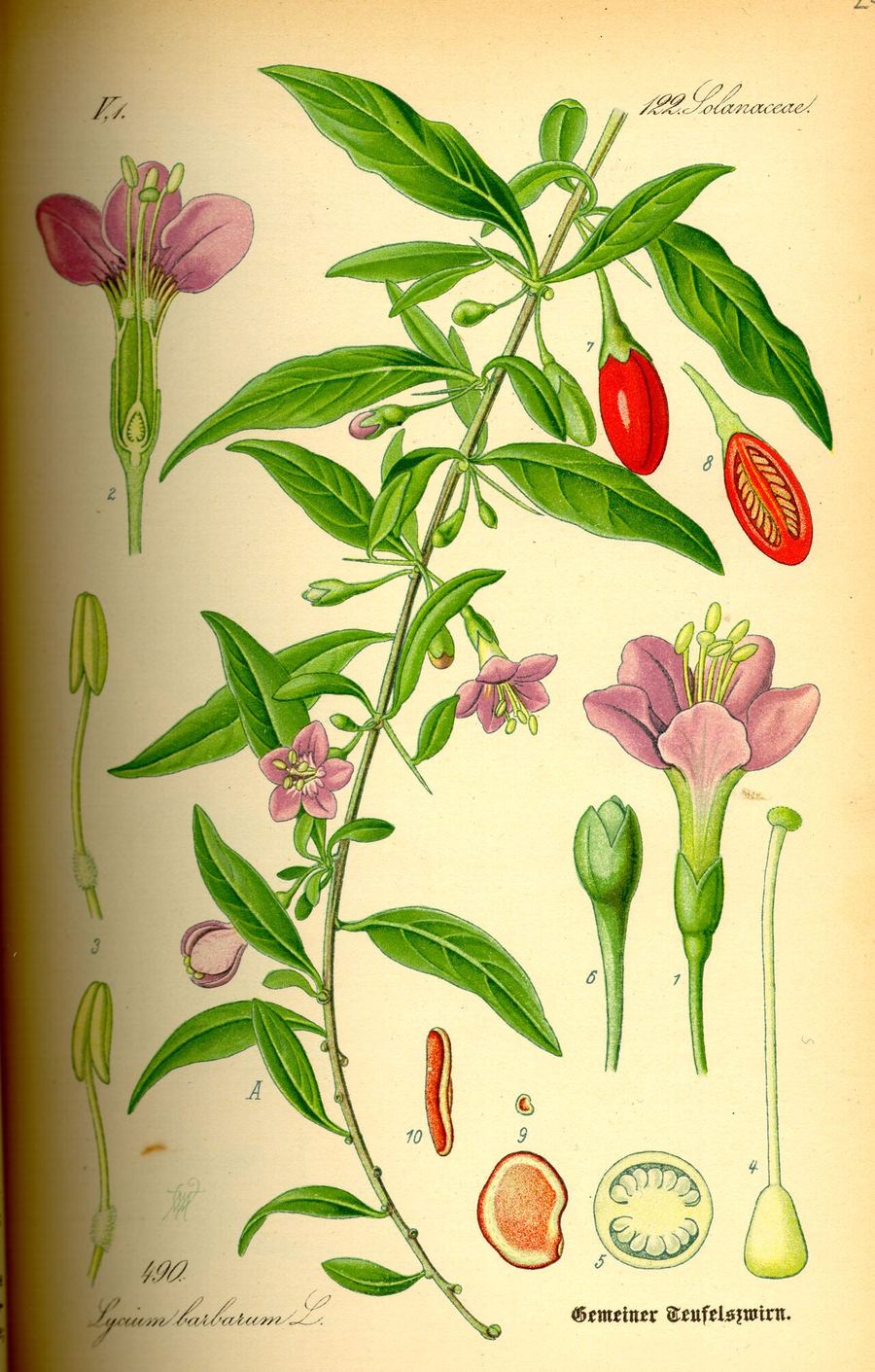
Goji berry
Lycium barbarum · 枸杞子
Fruits. Chinese Medicine and Modern nutrition.
Also called Gou qi zi, Wolfberry, Chinese wolfberry
Pinyin: Gǒu Qǐ Zǐ
Blood thinner interaction reportedA red berry eaten as food and used in Chinese medicine for eyes, energy and blood sugar. Human research is small.
Did you know? Goji berries are among the richest food sources of zeaxanthin, a yellow pigment found in the center of the eye's retina.
What it may help, and how strong the proof is
- Eyes & vision. A small 2021 pilot trial in healthy adults found that goji raised macular pigment over 90 days, while the lutein supplement group did not show the same rise. Larger trials are needed.Early proof
- Blood sugar. Lab and animal studies suggest goji may help blood sugar. Human trials are few and small.Traditional proof
- Colds, flu & immunity. Goji polysaccharides (sugar-like compounds) boost immune cells in lab and animal studies. Human proof is lacking.Traditional proof
Parts of the body
Traditional use
Traditional Chinese Medicine uses gou qi zi to nourish Liver and Kidney yin (cooling fluids) and to brighten the eyes. It is a key ingredient in Zuo Gui Wan (Restore the Left Kidney Pill) and Qi Ju Di Huang Wan.
How it is classified
- Herbal actions
- Nutritive, Antioxidant, Tonic. Energy: neutral.
- Chinese medicine
- 枸杞子 Tonify yin. Nature: neutral. Flavour: sweet. Enters the Liver and Kidney channels.
How people take it
Studies have used about 25 to 28 g of dried berries a day, roughly a small handful. Tea, juice and capsules are also common, with no firm standard dose.
Food, tea, powder, juice and capsule.
Where to get it
Grown mainly in northwest China, including Ningxia. Sold dried, as juice, tea, powder and capsules. Juices vary in sugar content, and some products mix in other fruit.
Be careful
Usually safe as food. High intake can cause stomach upset or diarrhea. Goji tea and wine have been linked to higher INR (a blood-thinning test result) in people taking warfarin.
Avoid if: bleeding disorders; diabetes medicines.
Mixing with other things
- Works well together
Goji and shu di huang are both in Zuo Gui Wan (Restore the Left Kidney Pill), a classic kidney formula.
- Works well together
Goji and shan zhu yu are both in Zuo Gui Wan.
- Works well together
Goji and tu si zi are both in Wu Zi Yan Zong Wan (Five Seeds Pill) for kidney weakness.
- Works well together
Goji and wu wei zi are both in Wu Zi Yan Zong Wan (Five Seeds Pill).
- Works well together
Nu zhen zi and goji are both used for Liver and Kidney yin in traditional tonic blends.
- Works well together
Du zhong and goji are both in You Gui Wan.
- Works well together
Often cooked together in sweet Chinese soups for moisture and flavor.
- Use cautionBlood thinners (warfarin, Eliquis, Xarelto, Plavix, daily aspirin)
Goji tea and wine have been linked to higher INR and bleeding in case reports on warfarin. Get INR checked if you drink goji regularly.
- Use cautionDiabetes medicine (metformin, insulin, glipizide, Ozempic)
Goji may lower blood sugar. Combined with diabetes medicines, sugar may drop too low, so monitor levels.
Adds up with others that may slow blood clotting: , , , , , , , , , , , , , and 40 more.
Adds up with others that may lower blood sugar: , , , , , , , , , , , , , and 39 more.
The honest take
Goji is a nutritious berry with a real but small eye-pigment signal in people. Claims about long life, energy and blood sugar rest mostly on tradition and lab work. Watch for warfarin interactions, and remember that many products also add sugar.