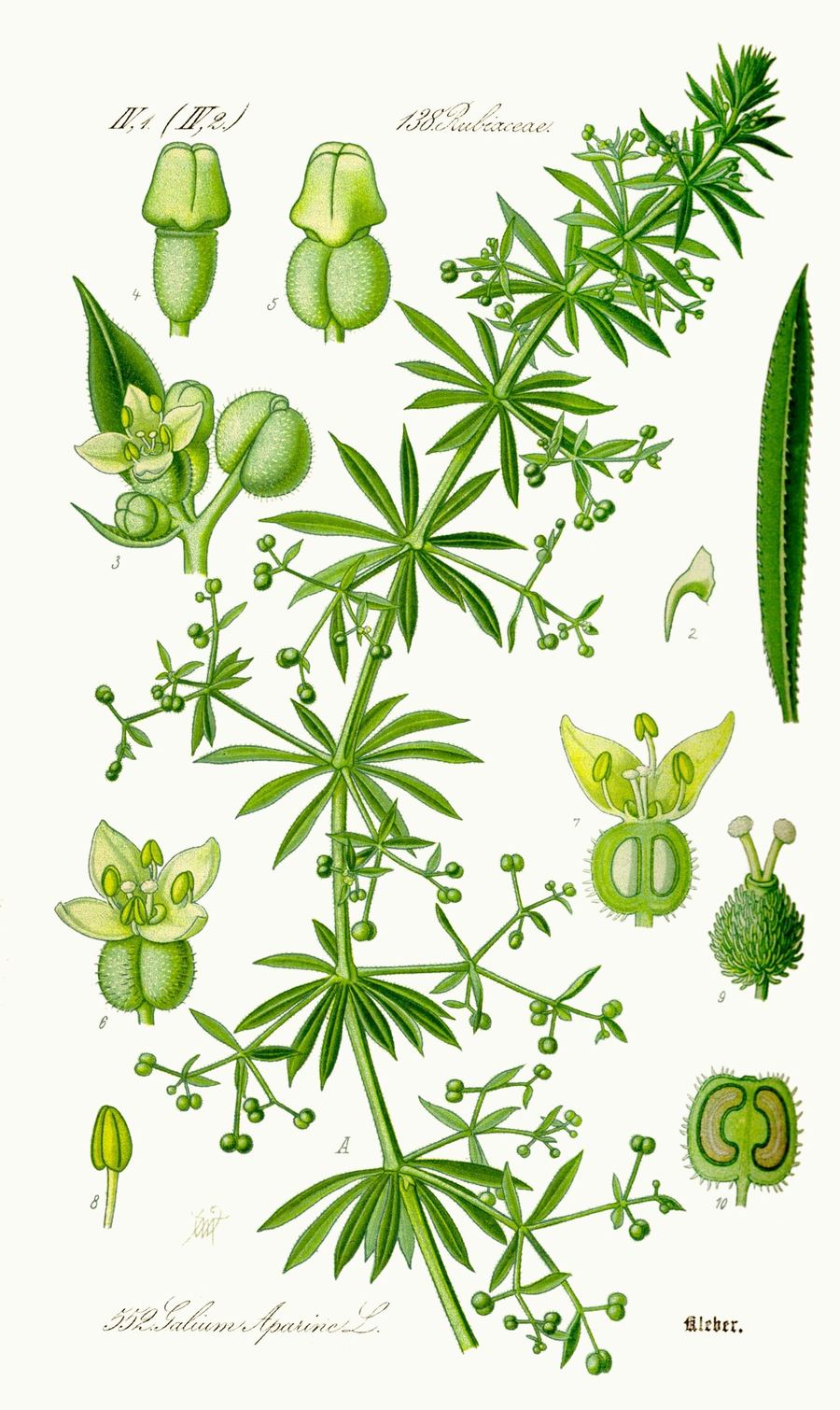
Cleavers
Galium aparine
Herbs & Roots. Western & European.
Also called Goosegrass, Sticky willy, Clivers
A sticky climbing weed used as a tea for lymph and urinary support.
Did you know? Its tiny hooked hairs cling to clothes and animal fur, and its seeds were once roasted and ground as a coffee substitute.
What it may help, and how strong the proof is
- Kidneys, bladder & UTIs. Used as a mild diuretic for urinary complaints. Mostly tradition and small lab studies.Traditional proof
- Cleansing & detox. Sold as a lymph cleanser or detox tea. No human trials show that it cleans the body or the lymph system.Not supported
Parts of the body
Traditional use
European herbalists used cleavers as a spring 'cleansing' tea and for swollen glands. Young shoots were also eaten as a green.
How it is classified
How people take it
Usually drunk as a tea a few times a day, from fresh or dried aerial parts. No standard human dose has been set.
Tea, juice and tincture.
Where to get it
Cleavers is a common weed of hedges, fields, and gardens across Europe, Asia, and North America. Dried herb and tinctures are sold in herb shops, and young spring shoots can be picked for salads.
Be careful
Fresh plants can irritate the skin because of their hooked hairs. Stomach upset is possible, and there are no good safety studies in pregnancy, so avoid it then. Pick only plants you can identify, away from roads and sprays.
Avoid if: pregnancy; breastfeeding.
Mixing with other things
- Works well together
Both are common in European spring cleansing teas.
- Works well together
Both are spring weeds used in folk tonic teas and salads.
The honest take
Cleavers is best known as a folk 'cleansing' herb, and that cleansing claim has no human proof. Its mild diuretic use and its role as a spring green are more realistic. Think of it as an ordinary wild herb, not a detox.