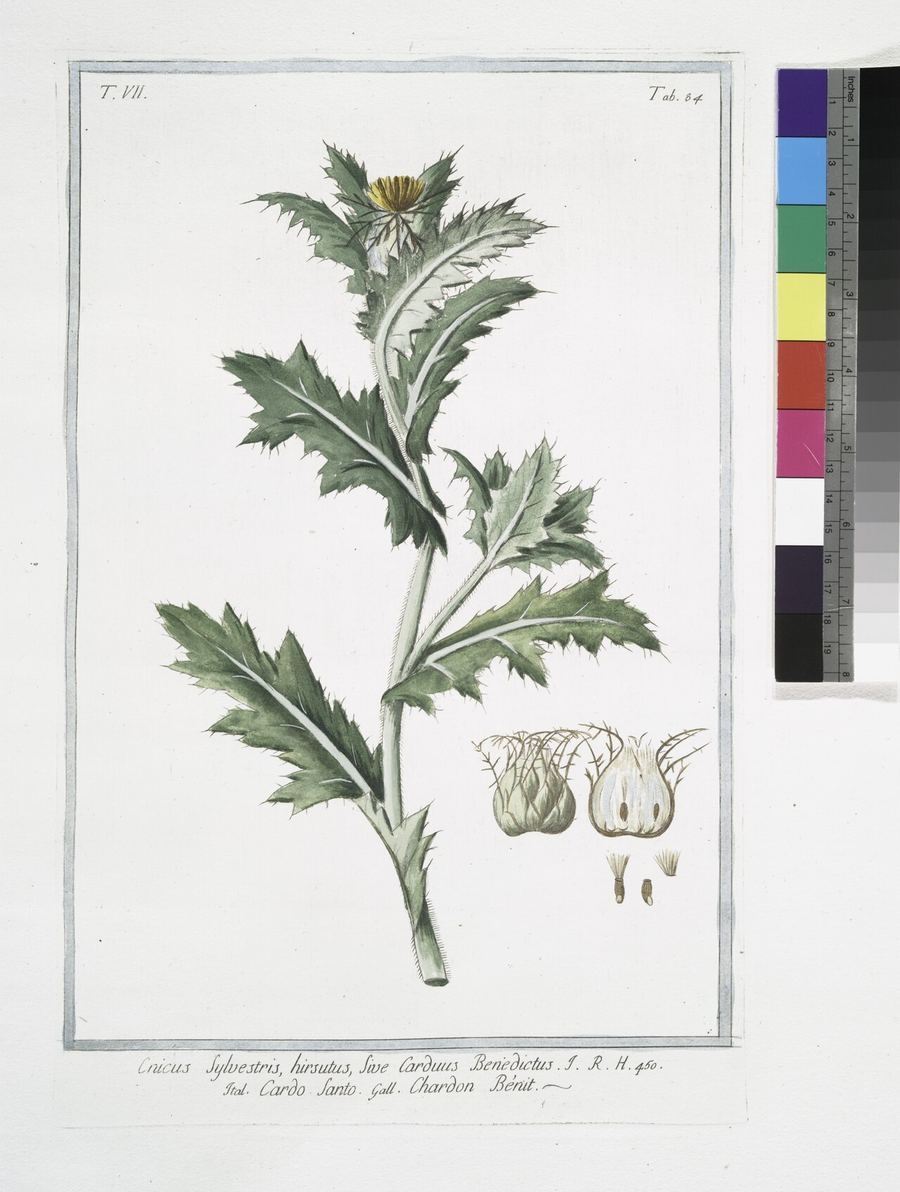
Blessed thistle
Cnicus benedictus
Herbs & Roots. Western & European and Dr. Sebi's list.
Also called Holy thistle, St. Benedict's thistle, Cnicus
Spanish: Cardo bendito
Avoid in pregnancyA spiny thistle used in folk remedies to boost breast milk and calm digestion.
Did you know? Old herbals called it holy thistle, because people once believed it protected against plague. Its name reflects that old belief.
What it may help, and how strong the proof is
- Women's health. Traditionally used to boost breast milk. No good human trials exist.Traditional proof
- Digestion & gut health. Bitter herb used for appetite and digestion. Little human research exists.Traditional proof
Parts of the body
Traditional use
European herbalists used it for digestion, fevers, and to boost breast milk. It is also on Dr. Sebi's herb list, but his disease claims for it are not supported by research.
How it is classified
- Herbal actions
- Galactagogue, Bitter, Hepatic. Energy: neutral.
How people take it
Tea is usually 1 to 2 teaspoons of dried herb per cup, up to three cups a day. Tinctures are taken by the dropper. No trial-based doses exist.
Tea and tincture.
Where to get it
Grows on dry, sunny ground across southern Europe, North Africa, and western Asia, and is grown as a herb. Sold as dried herb, tea, and tinctures.
Be careful
Can cause nausea or stomach upset, especially at high doses. Avoid it in pregnancy. People sensitive to ragweed or daisies may react.
Avoid if: pregnancy; ragweed allergy.
Mixing with other things
- Works well together
Both are used in folk blends to boost breast milk.
- Works well together
A common milk-supply herb in folk and Ayurvedic practice.
The honest take
Blessed thistle is used in folk practice for breast milk and digestion, but there are no good human trials for either use. The claim that it boosts milk is unproven. Dr. Sebi's list includes it, but his disease claims are not supported by research.